Rare 18K Multi-Gold Enamel Marchand Verge Fusee Pocket Watch c.1770
VC1-045

Product Details
This combination of eighteenth-century French watchmaking, 18K multi-color goldwork, enamel miniature painting, paste decoration, and an early verge-fusee movement makes the watch considerably more than a functional timekeeper. It is equally an example of the decorative arts of the period.
Details
MAKE
Maker:
Marchand
Country: France
Type: Gentleman's Pocket Watch
Serial / Movement Number: 31,871
Circa Date: 1770
Rarity: R9 – Extremely Rare
CASE
Material:
Solid 18K Multi-Color Gold
Size: 14 Size
Diameter: 44mm
Style: Open Face
Construction: Swing-Out
Decoration: Floral, Polychrome
Enamel & Paste Decoration
Back Scene: Waterside Landscape
with Tree, Ship & Fisherman
Condition: C2 – Perfect
DIAL
Material:
Porcelain
Color: White
Numerals: Roman Numerals
Hands: Filigree Hands
Winding: Dial Winding Aperture
for Key
Condition: D3-54 – Very Good
Condition Note: Chip at the
winding aperture
MOVEMENT
Maker:
Marchand
Movement Number: 31,871
Operation: Key Operated
Escapement: Verge
Power Transmission: Fusee
Finish: Gilt
Layout: Full Plate
Signed: Yes
Includes: Key
Condition: M3 – Very Good
Condition
The watch will be timed out and refreshed by our watchmaker if needed prior to shipment.
The photographs shown are professionally taken images of the actual item being offered for sale. We do not use stock photos, so the watch you see is the watch you will receive.
Please examine all photographs carefully, as they form an important part of the description and provide the best representation of the case, dial, movement, and overall condition.
This circa-1770 Marchand pocket watch remains
in exceptional
overall condition for its age.
The elaborate 18K multi-color gold, enamel,
and paste-decorated case is rated C2 – Perfect. The
preservation of the case is especially important given the intricate nature of
its decorative work.
The white porcelain dial is rated D3-54 – Very Good, with a chip at the
winding aperture. This condition issue is specifically
disclosed for accuracy.
The signed gilt verge-fusee movement is rated M3 – Very Good.
The watch is accompanied by a correct size winding key.
Offered here is an extraordinary French Marchand
gentleman’s pocket watch dating to approximately 1770,
combining early verge-fusee watchmaking with an exceptionally decorative 18K multi-color
gold, enamel, and paste-set case.
Measuring 44mm and 14 Size, the open-face
swing-out case is crafted in 18K multi-color gold and richly
decorated with floral motifs, enamel work, and paste accents. The case remains
in Perfect
condition, particularly impressive for a watch dating to the
eighteenth century.
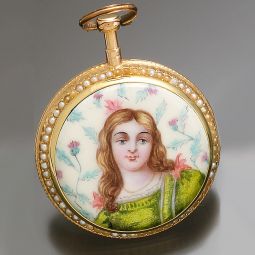
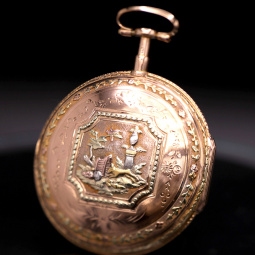
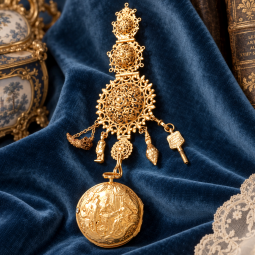
The highlight is the remarkable waterside enamel
scene on the back of the case. A detailed landscape depicts a tree, sailing
ship, and fisherman, creating a miniature work of art within
the watch. The scene is surrounded by elaborate multi-color gold ornamentation
and sparkling paste decoration, producing a highly dimensional, jewel-like
presentation.
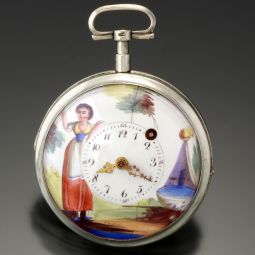
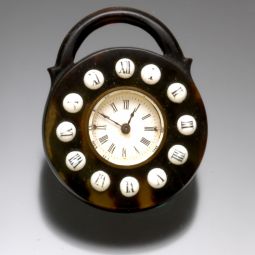
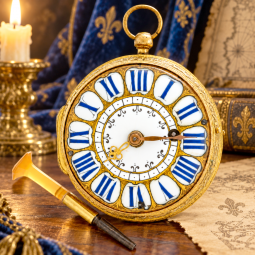
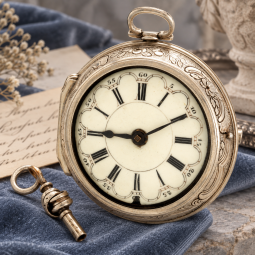
The front of the watch is considerably more
restrained. A traditional white porcelain dial features Roman
numerals and elegant filigree hands. The dial remains in Very Good condition,
with a chip
at the winding aperture noted for accuracy.
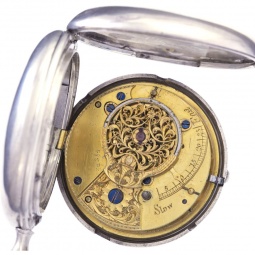
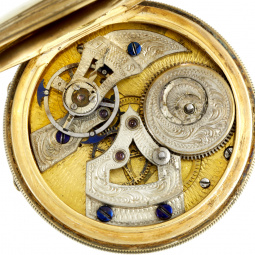
Inside is the signed gilt Marchand
movement No. 31,871, constructed with a traditional full-plate
layout, verge escapement, and fusee. The watch is key operated
and is accompanied by its key. The movement remains in Very Good condition.
With a stated R9 rarity rating,
this is an exceptionally unusual survivor and a particularly compelling watch
for collectors of early fusees, enamel watches, and highly decorative
eighteenth-century horology.
A Miniature Waterside Scene in Enamel
The extraordinary case back is the defining
visual feature of this watch.
Rather than conventional floral engraving
alone, the case incorporates a detailed waterside landscape depicting a tree, sailing ship,
and fisherman.
The scene creates a remarkable sense of depth
within a very small area. Its surrounding multi-color gold ornamentation acts
almost like a frame around a miniature painting, while the paste decoration
introduces additional brilliance as the watch catches the light.
This integration of watchmaking, miniature enamel
painting, goldwork, and jewelry decoration is precisely what
makes highly decorated eighteenth-century watches so fascinating.
18K Multi-Color Gold
& Paste Decoration
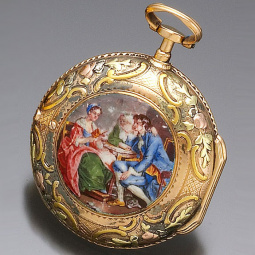
The case uses multiple tones of 18K gold
to enhance the floral ornamentation surrounding the central enamel scene.
Contrasting gold colors allow leaves, flowers,
borders, and other decorative elements to stand apart visually without relying
solely upon engraving.
The additional paste decoration
provides the sparkling appearance associated with gem-set decorative objects of
the period.
Importantly, I would retain the term “paste”
in the listing rather than describing these elements as gemstones. In antique
jewelry and watches, paste decoration is collectible in its own right and is an
important part of the watch's original decorative character.
Early Verge-Fusee
Watchmaking
Behind the elaborate exterior is a classic
example of early mechanical watchmaking.
The signed No. 31,871 gilt movement
uses a verge
escapement combined with a fusee, an arrangement characteristic
of an earlier era of portable timekeeping.
The fusee employs changing mechanical leverage
to compensate for variations in the force delivered by the mainspring as it
unwinds. This helped provide more consistent power to the movement.
The verge escapement represents one of
the earliest escapement systems extensively used in portable watches and is an
important feature for collectors interested in the development of mechanical
horology.
The movement's traditional full-plate
construction and gilt finish further reinforce its
eighteenth-century character.
Key Winding &
Setting
The watch predates the convenient
crown-winding systems that became familiar on later pocket watches.
A key is used to operate the watch,
and the original listing information identifies the movement as key set. The
dial's winding aperture provides access for winding the movement.
The inclusion of a key with the watch
adds to the completeness and presentation of this early timepiece.
What Makes This
Marchand Pocket Watch Special?
This watch combines several characteristics
rarely encountered together:
- Circa 1770 French manufacture
- Signed Marchand movement
- 18K multi-color gold case
- Elaborate floral
goldwork
- Detailed enamel waterside scene
- Tree, sailing ship
& fisherman imagery
- Decorative paste accents
- Perfect case condition
- Traditional
porcelain Roman numeral dial
- Early verge escapement
- Fusee power transmission
- Gilt full-plate
movement
- Includes a correct
sized key
- Stated R9 rarity
The unusual enamel scene is particularly
important. It gives this watch an individual artistic identity that separates
it from more conventionally decorated eighteenth-century fusee watches.