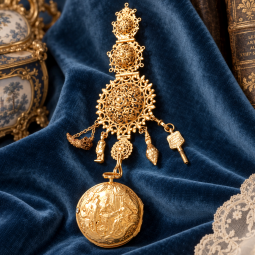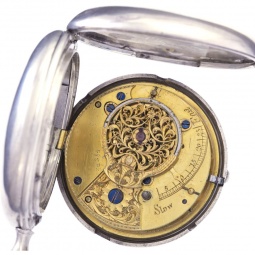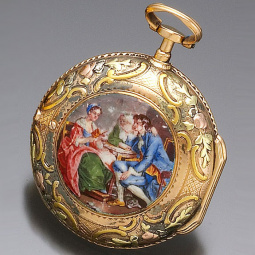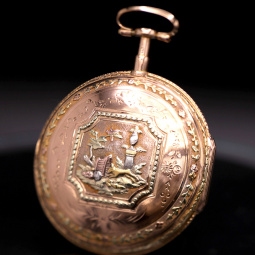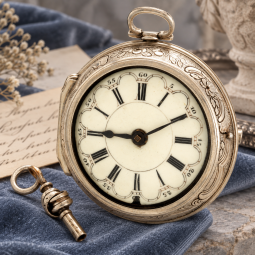
French Oignon Repoussé Gilt Pocket Watch c.1690 | Cut-Stone Watch Key
VC2-053

Product Details
With its circa-1690 date,
French Oignon form, repoussé and chased case, signed verge-fusee movement,
exceptional dial, and decorative cut-stone key, this is an impressive survivor
from the earliest period of collectible portable watchmaking.
Details
MAKE
Maker: Jean Angoille
Location:
Moulins, France
Type:
Man's Pocket Watch
Style:
Oignon
Circa
Date: 1690
Rarity:
R9 – Extremely Rare
CASE
Material: Gilt Brass
Color:
Yellow / Gilt
Size:
20 Size
Diameter:
Approximately 56mm
Style:
Open Face
Decoration:
Floral, Repoussé & Chased
Figural
Decoration: Two Dogs & Tree
Condition:
C3-15 – Very Good, Slightly Worn
DIAL
Color: White
Numerals:
Roman Numerals
Hands:
Filigree / Poker-Style Hands
Condition:
D2 – Perfect
MOVEMENT
Maker: Jean Angoille
Operation:
Key Operated
Escapement:
Verge
Power
Transmission: Fusee
Finish:
Gilt
Layout:
Full Plate
Signed:
Yes
Condition:
M3 – Very Good
INCLUDES
Decorative Cut-Stone
Watch Key
Condition
The watch will be timed out and refreshed by our watchmaker if needed prior to shipment.
The photographs shown are professionally taken images of the actual item being offered for sale. We do not use stock photos, so the watch you see is the watch you will receive.
Please examine all photographs carefully, as they form an important part of the description and provide the best representation of the case, dial, movement, and overall condition.
This
circa-1690 French Oignon pocket watch remains in remarkable overall
condition for its age.
The
richly decorated gilt brass case is rated C3-15 – Very Good,
with slight wear consistent with its considerable age. The repoussé and chased
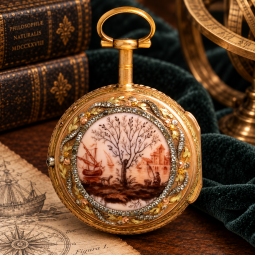
decoration remains visually impressive, including the distinctive
representation of two dogs and a tree.
Most
noteworthy is the dial, which is rated D2 – Perfect.
The
signed gilt verge-fusee movement is rated M3 – Very Good.
The
watch is accompanied by an unusually decorative cut-stone winding
key, an important part of the overall presentation.
The French Oignon Watch
The term “Oignon”, French for onion,
is traditionally associated with the large, thick, rounded watches produced in
France around the late seventeenth and early eighteenth centuries.
Their substantial proportions were
dictated in part by the mechanical architecture of the period, particularly the
large full-plate movements and fusee systems housed inside.
At approximately 56mm, this Jean
Angoille is an impressive example of the form. Its large case provides an
expansive surface for the elaborate repoussé and chased decoration that makes
the watch so visually distinctive.
Today, early Oignon watches are
particularly interesting to collectors because they represent an important
chapter in the development of the portable mechanical watch.
Repoussé & Chased Case
The case is one of the highlights of
this watch.
Its surface combines floral
ornamentation with a figural scene depicting two dogs and a tree, executed
using repoussé and chased techniques.
Repoussé creates raised decoration
by working the metal into relief, while chasing allows the craftsman to
refine details and textures from the visible surface.
Used together, these techniques
create depth and dimension that conventional engraving alone cannot achieve.
More than three centuries later, the surviving decoration provides a fascinating example of how early watch cases could serve simultaneously as protective housings and miniature works of decorative metalwork.
Early Verge-Fusee Movement
The signed gilt movement is built in
the traditional full-plate configuration and incorporates a verge escapement
with fusee.
The verge is one of the earliest
escapement systems widely employed in portable watches and is an important
characteristic of watches from this period.
The accompanying fusee helps
compensate for the changing force produced by the mainspring as it unwinds. Its
mechanical arrangement is fundamentally different from that of the later
nineteenth- and twentieth-century pocket watches most collectors encounter.
This early mechanical architecture
is an important part of the appeal of a watch dating to approximately 1690.
The Cut-Stone Watch Key
The accompanying cut-stone key
deserves particular attention.
Early watches required a separate
key for operation, but surviving keys range from purely functional objects to
elaborate pieces of jewelry in their own right.
This example falls firmly into the
decorative category. The faceted stone creates a jewel-like appearance that
beautifully complements the ornate character of the watch.
Presented together, the watch and
key provide a much more complete impression of the luxury and ceremony
associated with owning a fine portable timepiece during this period.
What Makes This Jean Angoille Oignon Special?
This watch brings together an
exceptional collection of early horological and decorative features:
- Circa 1690 French manufacture
- Signed Jean Angoille of Moulins
- Classic oversized French Oignon form
- 56mm / 20 Size proportions
- Gilt brass case
- Elaborate repoussé and chased decoration
- Unusual scene with two dogs and a tree
- Roman numeral dial rated Perfect
- Decorative filigree/poker-style hands
- Early verge escapement
- Traditional fusee
- Signed gilt full-plate movement
- Spectacular cut-stone watch key
- Stated R9 rarity
The combination of its early date,
elaborate casework, exceptional dial, signed movement, and decorative key makes
this a particularly compelling example of seventeenth-century French horology.