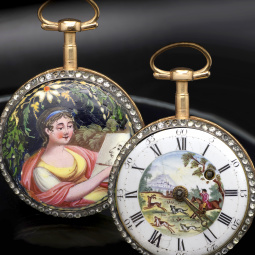
English Silver Repoussé Pair Case Verge Fusee Pocket Watch c.1705 | Tom Bolton
VC2-054

Product Details
Offered here is an exceptional
English sterling silver pair-case pocket watch dating to approximately 1705,
with a signed Tom Bolton of Stourbridge verge-fusee movement and a remarkably
early signed repoussé outer case by D. Cochin.
Details
MAKE
Watchmaker: Tom Bolton
Location:
Stourbridge, England
Type:
Man's Pocket Watch
Circa
Date: 1705
Rarity:
R8½ – Very Rare
CASE
Material: Sterling Silver
Style:
Pair Case
Size:
18 Size
Diameter:
Approximately 55mm
Decoration:
Repoussé
Repoussé
Signature: “D. Cochin”
Condition:
C3-15 – Very Good, Slightly Worn
DIAL
Material: Porcelain
Color:
White
Numerals:
Roman Numerals
Hands:
Spade Hands
Condition:
D3-21 – Very Good
Condition
Note: Soft Over-Glazed
MOVEMENT
Watchmaker: Tom Bolton
Operation:
Key Set
Escapement:
Early Verge Escapement
Power
Transmission: Fusee
Finish:
Gilt
Layout:
Full Plate
Signed:
Yes
Condition:
M3 – Very Good
INCLUDES
Silver Knot-Form Watch Key
Condition
The watch will be timed out and refreshed by our watchmaker if needed prior to shipment.
The photographs shown are professionally taken images of the actual item being offered for sale. We do not use stock photos, so the watch you see is the watch you will receive.
Please examine all photographs carefully, as they form an important part of the description and provide the best representation of the case, dial, movement, and overall condition.This
approximately 320-year-old English pair-case pocket watch remains in Very
Good overall condition.
The
sterling silver pair case is rated C3-15 – Very Good,
exhibiting slight wear consistent with its considerable age. Importantly, the
elaborate repoussé decoration remains visually impressive, including the
unusual “D.
Cochin” signature.
The
white porcelain Roman numeral dial is rated D3-21 – Very Good,
with a soft over-glazed surface noted.
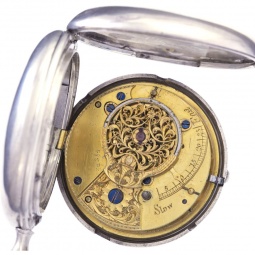
The
signed Tom Bolton gilt verge-fusee movement is rated M3 – Very Good.
A
silver
knot-form watch key accompanies the watch and adds considerably
to its presentation as an early key-operated timepiece.
Please
examine all photographs carefully, as they form an important part of the
description and provide the best representation of the casework, dial,
movement, and key.
The English Pair-Case Watch
The
pair
case is an important feature of English watchmaking during the
seventeenth and eighteenth centuries.
Rather
than relying upon a single case, the watch is housed within an inner case that
protects the movement and dial, which in turn fits into a separate outer
protective case.
The
outer case also provided an ideal surface for decorative metalwork. In
exceptional examples such as this watch, it became a miniature work of art in
its own right.
At
approximately 55mm, this example has substantial
proportions that allow the repoussé decoration to be particularly impressive.
--->View The History of Oignon & Pair Case Pocket Watches.
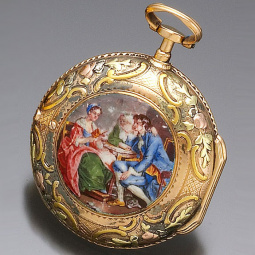
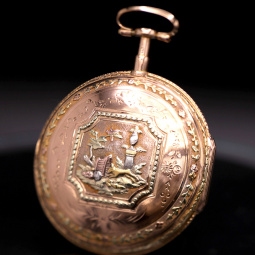
Signed D. Cochin Repoussé Case
The
decorative outer case is one of the most significant aspects of this watch.
Repoussé is a metalworking technique in which
the metal is worked to produce decoration in raised relief. The resulting
three-dimensional surface gives considerably greater depth than conventional
flat engraving.
Even
more interesting is the presence of the “D. Cochin” signature.
According
to the expert opinion accompanying the watch, finding signed repoussé work
from this early period is unusual. This signature therefore
deserves to be prominently documented in both the written description and your
close-up photography.
The
signed casework and signed movement also provide an interesting combination of
identifiable decorative craftsmanship and watchmaking within a single early
eighteenth-century object.
Tom Bolton of Stourbridge
The
watch incorporates a signed Tom Bolton, Stourbridge
movement.
Its
gilt full-plate
construction, verge escapement, and fusee are representative of
the mechanical architecture encountered in early English portable watches.
The
contrast between the richly decorated outer case and the mechanical
construction hidden inside is part of what makes an early pair-case watch so
fascinating to examine.
Early Verge-Fusee Movement
At
the heart of the watch is a traditional verge-fusee movement.
The
verge represents one of the earliest escapement systems extensively employed in
portable mechanical watches.
The
fusee
works in conjunction with the mainspring to compensate for changes in its power
as it unwinds. By varying the mechanical leverage supplied to the movement, the
system was intended to provide more consistent force to the timekeeping
mechanism.
Combined
with the gilt full-plate architecture, these features place the watch firmly
within the mechanical traditions of the early eighteenth century.
--->View What is a Verge Fusee Movement and How to Wind Pocket Watches.
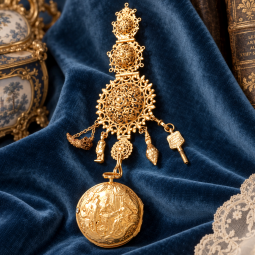
Silver Knot Watch Key
The
accompanying silver knot-form key provides an attractive
finishing element to the presentation.
Early
watches required a separate key for operation, making the key an essential
accessory rather than simply an ornamental addition.
Decorative
keys could also become personal objects in their own right. The unusual
knot-form design of this example is particularly appropriate when displayed
alongside the ornate silver pair case.
What Makes This Watch Special?
Several
characteristics distinguish this early English pocket watch:
- Circa
1705
- Tom Bolton of Stourbridge,
England
- Oversized 55mm / 18 Size
- Sterling
silver pair case
- Elaborate repoussé outer
case
- Repoussé work signed “D.
Cochin”
- White porcelain Roman numeral dial
- Traditional spade hands
- Signed gilt full-plate
movement
- Early verge
escapement
- Fusee power transmission
- Accompanied by a silver
knot-form watch key
- Very Good overall condition
- Stated R8½ rarity
The combination of its early date, signed decorative casework, traditional English pair-case construction, signed movement, and accompanying key makes this a particularly interesting example of early eighteenth-century English horology.