Rare Bertram London One-Hand Verge Fusee Pocket Watch c.1660 — Pre-Hairspring
VC2-062

Product Details
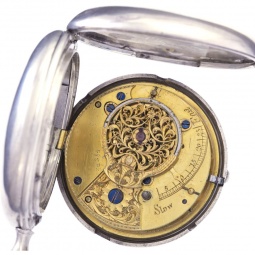
An extraordinary survivor from
the earliest period of English portable timekeeping, this Bertram of London single-hand verge
fusee watch, dating to approximately 1660, represents a
fascinating chapter in the development of mechanical horology.
Dating from the pre-balance-spring era,
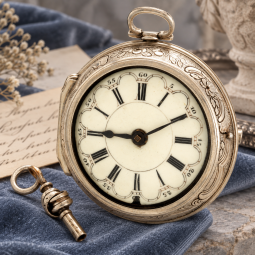
this exceptionally early timepiece features a single-hand silver dial, Roman numerals, a verge escapement
with fusee power transmission, and an early set-up regulator.
MAKE
Maker / Signature: Bertram
Location: London, England
Type: Gentleman's Early Pocket / Portable Watch
Circa Date: 1660
Historical Period: Seventeenth Century
Rarity: R10 – Extremely Rare
CASE
Material: Sterling Silver
Size: 14 Size (as cataloged)
Diameter: 40mm
Style: Open Face
Construction: Swing-Out
Decoration: Plain
Condition: C2 – Perfect
DIAL
Material / Color: Silver
Numerals: Roman
Hands: Single Poker-Style Hand
Time Display: Single-Hand Hour Indication
Condition: D2 – Perfect
MOVEMENT
Maker / Signature: Bertram
Type: Mechanical
Escapement: Verge
Power Transmission: Fusee
Historical Construction: Pre-Balance-Spring / Pre-Hairspring
Regulator: Set-Up Regulator
Finish: Gilt
Layout: Full Plate
Setting: Key Set
Signed: Yes
Condition: M2 – Perfect
INCLUDES
Watch Key: Included
CONDITION & RARITY
Case: C2 – Perfect
Dial: D2 – Perfect
Movement: M2 – Perfect
Rarity: R10 – Extremely Rare
For the serious collector of early English watches, seventeenth-century horology, and historically important mechanical timepieces, this Bertram offers a remarkable opportunity to acquire an example of watchmaking from the era preceding modern precision timekeeping.
An Exceptional Survivor from
Seventeenth-Century England
The most important aspect of
this watch is its extraordinary early date.
Dating to approximately 1660,
it belongs to an era when mechanical watches were still developing from their
sixteenth-century origins.
Portable watches of this period
were considerably different from the precise timekeeping instruments that would
emerge during the eighteenth and nineteenth centuries.
Their movements were generally
larger, their construction more elaborate, and their ability to maintain
consistent time substantially more limited.
A surviving example with a
single-hand dial, verge escapement, fusee mechanism, and pre-hairspring
construction provides an unusually direct connection to this formative period
in horological history.
Pre-Hairspring Watchmaking —
Before Modern Precision
One of the most historically
significant features is the pre-hairspring movement.
The balance spring, or
hairspring, became an important development in portable watchmaking during the
later seventeenth century.
Before its introduction,
watches relied on earlier balance-wheel regulation systems that were more
susceptible to variations in driving force and external conditions.
These watches were not expected
to achieve the level of accuracy associated with later mechanical timepieces.
The introduction of the balance
spring greatly improved the potential accuracy of portable watches and helped
establish the foundations of modern mechanical watchmaking.
This Bertram represents the
earlier tradition, making its construction especially interesting to collectors
studying the evolution of the escapement and regulating system.
Single-Hand Silver Dial
The watch features an elegant
silver dial with Roman numerals and a single poker-style hand.
Single-hand watches are closely
associated with the earliest centuries of portable mechanical timekeeping.
Rather than displaying separate
hour and minute hands, these watches generally indicated the approximate hour
using one pointer.
This was appropriate to the
timekeeping capabilities of the period, when portable watches were often valued
as much for their craftsmanship and technical ingenuity as for their accuracy.
The simplicity of the dial is
one of the most visually compelling aspects of this example.
Its restrained silver finish,
traditional Roman numerals, and single hand create an unmistakably early
appearance.
The dial remains in D2 –
Perfect condition.
Early Verge Escapement
The movement incorporates a
verge escapement, one of the earliest escapement systems used in mechanical
watches.
The verge escapement uses a
rotating escape wheel and a verge fitted with pallets to regulate the release
of energy through the movement.
This mechanism was fundamental
to the development of early portable timepieces and remained in use for
centuries.
In a watch dating to
approximately 1660, the verge escapement is an especially appropriate and
historically important feature.
Its presence helps illustrate
the mechanical principles used by watchmakers before the development of later
lever and cylinder escapements.
--->View What is a Verge Fusee Movement and How to Wind Pocket Watches.
Fusee Power Transmission
The watch also incorporates a
fusee, a sophisticated mechanical system developed to help compensate for
variations in mainspring force.
As a mainspring unwinds, the
force it delivers changes.
The fusee uses a specially
shaped cone and connecting chain or cord to alter the mechanical leverage as
the mainspring releases its energy.
This arrangement was
particularly valuable in early watches, where maintaining a reasonably
consistent driving force was an important technical challenge.
The combination of a verge
escapement and fusee transmission is a defining characteristic of early
European watchmaking.
Early Set-Up Regulator
Another noteworthy feature is
the set-up regulator.
In early watchmaking, set-up
mechanisms were associated with the regulation of mainspring tension and the
delivery of power through the movement.
This feature is especially
interesting because it reflects the mechanical approaches used before the
widespread adoption of more advanced regulating systems.
Its presence adds to the
historical and technical appeal of the Bertram movement.
R10 — Extremely Rare
This Bertram has been assigned
a rarity rating of R10 – Extremely Rare.
Early English watches from the
pre-balance-spring era occupy a specialized and historically important area of
horological collecting.
The survival of a watch from
approximately 1660 is noteworthy, particularly when its early mechanical
features remain identifiable.
Its single-hand dial, verge
fusee construction, signed movement, and early regulator make this an
especially interesting study piece.
For collectors focused on the
origins of English watchmaking, these features may be more significant than
conventional decorative complications.
Collector Highlights
·
Bertram
— London, England
·
Circa
1660
·
Seventeenth-century
English horology
·
Pre-hairspring
/ pre-balance-spring construction
·
Single-hand
time display
·
Silver
dial
·
Roman
numerals
·
Poker-style
hand
·
Early
verge escapement
·
Fusee
power transmission
·
Set-up
regulator
·
Signed
gilt full-plate movement
·
40mm
sterling silver case
·
Open-face
construction
·
Watch
key included
·
C2
– Perfect case
·
D2
– Perfect dial
·
M2
– Perfect movement
·
R10
– Extremely Rare
This remarkable Bertram brings
together several defining features of early English watchmaking, offering a
fascinating glimpse into the mechanical ingenuity of the seventeenth century.