Ball Watch Co. (Hamilton) Railroad Pocket Watch CA1907 | Loaner Case with “Return to” Hang Tag
ITEM-2741

Product Details
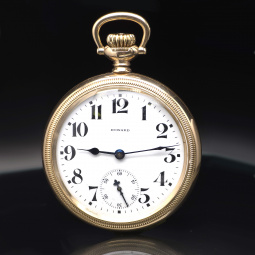
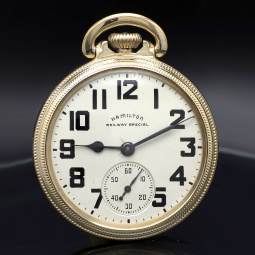
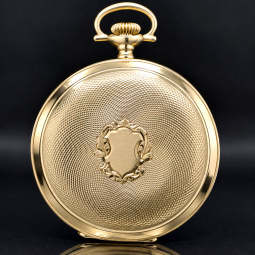
Offered here is an exceptionally interesting Ball Watch Co. railroad pocket watch with a Hamilton movement, dating to approximately 1907, housed in a scarce railroad loaner case and, most importantly, retaining its associated “Return To” identification hang tag.
Details:
MAKE
Manufacturer: Ball Watch Co.
(Hamilton)
Country: USA
Type: Man’s
Serial #: 534025
Circa Date: 1907
CASE
Size: 18 Size.
Style: Open Face.
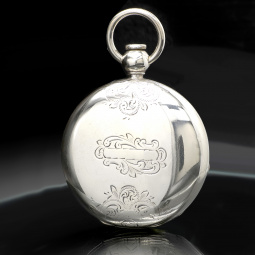
Material: Silveroid.
Decorations: Plain.
Conditions: C 3 (The
case is in Very Good condition)
DIAL
Color: White.
Type: Single sunk porcelain dial.
Numerals: Arabic Numerals.
Hands: Spade Hands.
Conditions: D 3-50 (The dial is in Very Good condition –
hairline(s) barely visible)
MOVEMENT
Jewels: 17 Jewels.
Setting: Lever Set.
Escapement: Lever Escapement.
Material: Nickel.
Layout: Full Plate Layout.
Signed: Yes.
Conditions: M 3 (The movement is in Very Good
condition)
CONDITION
The
watch will be timed out and refreshed by our watchmaker if needed prior to
shipment.
The photographs shown are professionally taken images of the actual item being offered for sale. We do not use stock photos, so the watch you see is the watch you will receive.
Please
examine all photographs carefully, as they form an important part of the
description and provide the best representation of the unusual square case,
dial, movement, and overall condition.
The loaner-watch configuration gives this piece a direct connection to the working railroad time-inspection system. Railroad loaner watches were practical working instruments: they could be supplied temporarily when an employee's regular watch was being serviced or otherwise unavailable, allowing the employee to remain equipped with an appropriate timepiece.
Surviving loaner watches are desirable pieces of railroad horology in their own right. This example is particularly compelling because its history did not end with the watch—the identifying return hang tag has survived with it.
Independent auction documentation identifies this very watch as a Ball Hamilton 17-jewel, 18 Size loaner, with the case marked for “G.W. Berisford, 169, Piedmont, W.Va.” and its surviving tag directing that the watch be returned to G.W. Berisford in Piedmont, West Virginia.
Even more importantly, that documentation identifies George William Berisford as a watch inspector for the Baltimore & Ohio Railroad, giving the watch documented personal provenance connected to railroad time inspection.
For Ashland Watches, this is also the first railroad loaner watch we have encountered retaining this type of “Return To” hang tag, making the complete surviving presentation particularly noteworthy.
This is much more than an early Ball railroad watch. The combination of the Ball/Hamilton movement, railroad loaner case, surviving return tag, and documented association with B&O Railroad watch inspector George William Berisford gives the watch a tangible connection to the actual system of railroad time inspection in the early twentieth century.
What Was a Railroad Loaner
Watch?
A railroad employee's watch was
an essential piece of working equipment, not merely a personal accessory.
Railroad timekeeping systems
depended upon employees maintaining watches that satisfied prescribed standards
and submitting those watches for regular inspection. When a watch required
servicing, a loaner watch
could provide a temporary replacement, allowing the
employee to continue working with an appropriate timepiece.
Period loaners therefore
represent an interesting part of the infrastructure surrounding railroad watch
inspection rather than simply another variation of pocket-watch case.
Other documented Ball loaner
watches survive with cases identifying the watch inspector or business
responsible for the watch. Collector records, for example, document Ball loaner
cases associated with individual watch inspectors and jewelry/watch businesses.
The Rare “Return To” Hang Tag
The surviving hang tag may be
the most fascinating feature of this particular watch.
A loaner case can identify a
watch's function, but the accompanying tag helps explain where this individual watch belonged and
to whom it was to be returned.
In our experience, this is the first loaner-case railroad watch we have
encountered retaining such a “Return To” hang tag.
George William Berisford &
the B&O Railroad
The personalization of this
watch is particularly meaningful because G.W.
Berisford was not simply an unidentified previous owner.
Independent auction research
identifies him as George
William Berisford, a watch inspector for the Baltimore & Ohio Railroad.
The case and tag associate him with Piedmont,
West Virginia.
That documented association
substantially strengthens the historical interest of the piece.
Rather than merely representing
the type of watch that might have passed through a railroad inspector's hands,
this example can be connected to a named
B&O Railroad watch inspector and the location from which his loaner watch
was administered.
Ball, Hamilton & Railroad
Timekeeping
The Ball Watch Co. name
occupies an important place in American railroad horology.
Ball did not simply sell
watches bearing its name. The company became closely associated with railroad
time inspection and the standards surrounding watches used in railroad service.
Hamilton was among the American
manufacturers that produced movements associated with Ball watches, making the Ball-Hamilton relationship
an important part of collecting railroad timepieces.
In this particular example,
however, the historical importance goes beyond the manufacturer. The loaner
case and Berisford tag preserve evidence of the inspection and service network in which railroad watches
actually operated.
It is not simply a
railroad-grade watch from the period. It is an artifact associated with the
system through which railroad employees' watches were inspected, maintained,
and temporarily replaced.
For a collection centered on Ball watches, Hamilton railroad watches,
railroad time inspection, B&O Railroad history, railroad loaner watches, or
occupational horology, this is an unusually compelling piece.