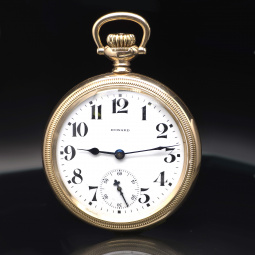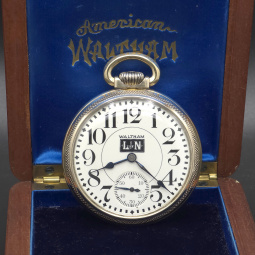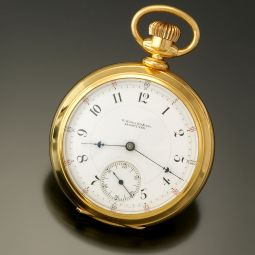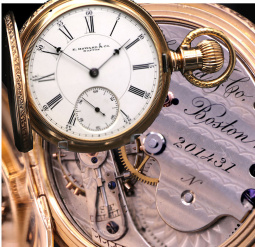
Triple Signed Howard Series O Railroad Pocket Watch c.1913 | 23 Jewel, 16 Size
ITEM-2752

Product Details
This handsome
American railroad pocket watch is described as triple signed, an especially appealing
characteristic for collectors who appreciate manufacturer identification and
period-correct presentation.
The Howard Series O
represents an important chapter in American railroad watchmaking, combining
sophisticated mechanical construction with the practical requirements of
precision timekeeping during the early twentieth century.
Details:
MAKE
Manufacturer: Howard
Model: Series O
Country: USA
Type: Man’s
Serial #: 1155619
Circa Date: 1913
CASE
Size: 16 Size.
Style: Open Face.
Material: Yellow Gold Filled.
Decorations: Plain.
Conditions: C 3 (The
case is in Very Good condition)
DIAL
Color: White.
Type: Double sunk porcelain dial.
Numerals: Arabic Numerals.
Hands: Spade Hands.
Conditions: D 3 (The dial is in Very Good condition)
MOVEMENT
Jewels: 23 Jewels.
Setting: Lever Set.
Escapement: Lever Escapement.
Material: Nickel.
Layout: Bridge Style Layout.
Signed: Yes.
Conditions: M 3 (The movement is in Very Good
condition)
Please
examine all photographs carefully, particularly the signatures, dial, case
surfaces, and movement, as the photographs form an important part of the
description.
With its 23-jewel Howard Series O movement,
triple-signed presentation, double-sunk porcelain dial, and traditional
railroad-watch construction, this is a particularly desirable
example for collectors of American railroad watches and high-grade Howard
timepieces.
Dating to
approximately 1913,
it represents an era when dependable railroad timekeeping was essential to the
safe and efficient operation of America's expanding railway network.
Howard
Series O — A High-Grade American Railroad Watch
The Howard
Series O is an important model for collectors of American railroad pocket
watches.
Howard watches
were known for their quality construction and association with precision
timekeeping.
The Series O
combined traditional American pocket-watch engineering with features
appropriate to demanding railroad service.
This example
is equipped with a 23-jewel movement, placing it among the higher-jewel-count
mechanical pocket watches of its period.
The
combination of the Howard name, Series O designation, and 23-jewel construction
makes this watch particularly appealing to collectors seeking high-grade
American railroad timepieces.
Triple-Signed
Presentation
An especially
interesting feature of this watch is its triple-signed presentation.
Collectors
frequently use the term triple signed to describe a watch bearing coordinated
manufacturer identification on three principal components, commonly the dial,
movement, and case.
Such markings
can add interest to a vintage watch, particularly when the signatures are
appropriate to the manufacturer and production period.
For this
Howard, the triple-signed designation is an important part of its collector
appeal.
The exact
locations and wording of all three signatures should be confirmed from the
watch itself.
23-Jewel
Nickel Bridge Movement
The movement
is one of the principal attractions of this watch.
The Howard
Series O movement, serial number 1,155,619, features 23 jewels and an
attractive nickel bridge-style layout.
The bridge
construction provides a distinctive view of the movement's mechanical
components and finishing.
Jewels are
used at selected bearing and friction points to reduce wear and support
reliable mechanical operation.
The movement
features a lever escapement, a design widely used in high-quality American
pocket watches.
It remains in
M3 – Very Good condition.
Lever-Set
Railroad Construction
This Howard
uses a lever-setting mechanism, a feature strongly associated with American
railroad pocket watches.
Unlike a
pendant-set watch, where the crown is pulled outward to adjust the hands, a
lever-set watch requires a separate setting lever to be moved into position.
This
arrangement helps prevent accidental changes to the time while the watch is
being wound or handled.
Lever setting
became an important requirement in many railroad timekeeping standards because
accurate time indication was essential to safe train operations.
Double-Sunk
Porcelain Dial
The watch
features a beautiful white double-sunk porcelain dial with bold Arabic numerals
and traditional spade hands.
Double-sunk
construction creates recessed areas within the dial, typically including the
central section and subsidiary seconds register.
This produces
additional depth and gives the dial a refined appearance.
The clear
Arabic numerals and contrasting hands reflect the emphasis on legibility that
characterized American railroad-watch design.
The dial
remains in D3 – Very Good condition.
Classic
16 Size Gold-Filled Case
The watch is
housed in a traditional 16 Size yellow gold-filled open-face case.
Its plain
finish provides a restrained appearance that complements the sophisticated dial
and movement.
The open-face
configuration allows the time to be read immediately without opening a
protective cover.
Gold-filled
cases were widely used in American railroad watches, offering the attractive
appearance of gold with practical durability.
The case
remains in C3 – Very Good condition.
American
Railroad Timekeeping in 1913
Dating to
approximately 1913, this Howard was manufactured during a period when American
railroads depended heavily on accurate personal timepieces.
Before
electronic communication and modern centralized signaling systems became
widespread, precise timekeeping was essential to coordinating train movements.
Railroad
employees were often required to carry watches meeting specific standards for
accuracy, construction, and readability.
High-grade
pocket watches such as the Howard Series O reflect the importance placed on
reliable mechanical timekeeping during this period.
Although this
example has the characteristics of a railroad-grade watch, its individual
service history has not been documented.