Hamilton 992B Railroad Pocket Watch c.1956 | 21J | Adjusted 6 Positions
ITEM-2756

Product Details
The Hamilton 992B is among the most recognizable and
respected American railroad pocket watches of the twentieth century. Introduced
in 1940, the 992B represented an important development in Hamilton's
railroad-watch production, combining precision engineering with the demanding
requirements of professional railroad timekeeping.
Details:
MAKE
Manufacturer: Hamilton
Model: 992B
Country: USA
Type: Man’s
Serial #: C428594
Circa Date: 1956
CASE
Size: 16 Size.
Style: Open Face.
Material: White Gold Filled.
Decorations: Plain.
Conditions: C 3 (The
case is in Very Good condition)
DIAL
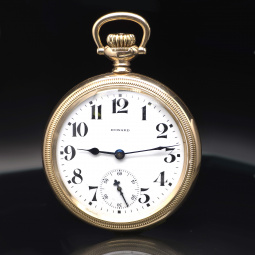
Color: White.
Type: Metal.
Numerals: Arabic Numerals.
Hands: Spade Hands.
Conditions: D 3-36 (The dial is in Very Good condition –
Restored with a Later Dial)
MOVEMENT
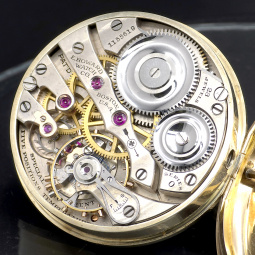
Jewels: 21 Jewels.
Setting: Lever Set.
Escapement: Lever Escapement.
Adjusted: Adjusted to 6 positions and Temp
Material: Nickel.
Layout: ¾-Plate Layout.
Signed: Yes.
Conditions: M 3 (The movement is in Very Good
condition)
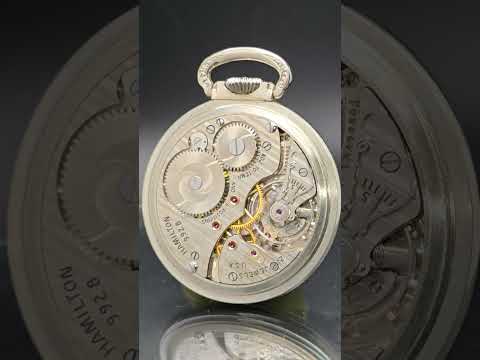
Watch Video
Video will open in a new window
Using the eBay App? Paste link into a browser window:
With
its 21-jewel Hamilton 992B movement, classic white gold-filled case, lever-set
construction, and traditional railroad styling, this pocket watch offers an
appealing example of American precision watchmaking from the 1950s.
For
collectors of Hamilton watches, American railroad timepieces, and high-grade
mechanical pocket watches, the 992B remains an enduring favorite.
21-Jewel
Hamilton 992B — Adjusted to 6 Positions and Temperature
At the heart of this pocket
watch is the celebrated Hamilton
992B 21-jewel movement, serial number C428594, featuring
nickel-finished three-quarter-plate construction, lever setting, and a
precision lever escapement.
Of particular importance is the
movement's adjustment to
six positions and temperature, a hallmark of high-grade
American railroad watchmaking.
Adjustment to six positions was
intended to minimize variations in timekeeping when the watch was held in
different orientations. Temperature adjustment was designed to reduce changes
in rate caused by fluctuations in temperature.
These adjustments were
especially important for railroad timepieces, where dependable accuracy was
essential to coordinating train movements safely.
The Hamilton 992B also
incorporated Hamilton's Elinvar
Extra hairspring technology, designed to improve temperature
stability.
Together, the 21-jewel construction, six-position
adjustment, temperature compensation, and lever-setting mechanism
demonstrate the sophisticated engineering that made the Hamilton 992B one of
America's most respected railroad pocket watches.
Hamilton 992B — An American
Railroad Classic
The Hamilton 992B holds an
important place in the history of American railroad timekeeping.
Introduced in 1940 as the
successor to the earlier Hamilton 992, the 992B incorporated a redesigned
movement intended to provide dependable performance under demanding service
conditions.
Its robust construction,
21-jewel configuration, and railroad-oriented features helped establish the
model as one of Hamilton's best-known pocket watches.
The 992B remained in production
for decades and became closely associated with the final generations of
American railroad pocket-watch use.
Today, it is highly regarded by
collectors for its mechanical quality, historical significance, and classic
American styling.
21-Jewel Hamilton 992B
Movement
The movement is the principal
attraction of this watch.
The signed Hamilton 992B
movement, serial number C428594, features 21 jewels and a traditional
nickel-finished plate layout.
The 21-jewel construction
incorporates jeweled bearings at important friction points, helping reduce wear
and support consistent mechanical operation.
The 992B is also known for its
use of Hamilton's Elinvar Extra hairspring technology, which was developed to
improve temperature compensation in mechanical timekeeping.
The movement's traditional
construction and high jewel count reflect the emphasis placed on dependable
performance in American railroad watches.
This example remains in M3 –
Very Good condition.
Lever-Set Railroad
Construction
This Hamilton features lever
setting, an important characteristic of traditional American railroad pocket
watches.
Unlike a pendant-set watch,
where the crown is pulled outward to adjust the hands, a lever-set watch
requires a separate setting lever to be moved into position.
This system helped prevent
accidental changes to the indicated time while winding or handling the watch.
Lever setting became an
important feature of watches intended for railroad service, where maintaining
accurate and dependable time indication was essential.
Classic 16 Size White
Gold-Filled Case
The watch is housed in a 16
Size white gold-filled open-face case.
Its plain exterior gives it a
restrained, professional appearance appropriate to a traditional railroad
watch.
White gold-filled cases provide
an attractive silver-toned appearance through a bonded gold layer over a
base-metal core.
The open-face design allows the
time to be read immediately without opening a protective cover.
The case remains in C3 – Very
Good condition.
Traditional White Railroad
Dial
The white metal dial features
bold Arabic numerals and traditional spade hands.
This classic arrangement
emphasizes legibility, one of the defining characteristics of American
railroad-watch design.
The contrasting numerals and
hands make the dial easy to read at a glance.
Important Dial Restoration
Disclosure
The dial is rated D3-36 – Very
Good Condition, Restored with a Later Dial.
This means the watch presently
has a later replacement dial rather than its original production-period dial.
For collectors, this
distinction is important because originality can affect historical interest and
value.
The later dial retains the
traditional appearance associated with Hamilton railroad watches while
providing an attractive, readable presentation.
American Railroad Timekeeping
in the 1950s
Dating to approximately 1956,
this Hamilton was manufactured during a period of significant change in
American transportation.
Railroads continued to play an
important role in passenger travel, freight transportation, and industrial
commerce, even as automobiles, commercial aviation, and other technologies
transformed the transportation landscape.
Reliable mechanical timekeeping
remained important to railroad operations.
The Hamilton 992B was among the
American pocket watches associated with this tradition of precision and
dependable service.
This example provides an
appealing connection to the later decades of American railroad-watch history.