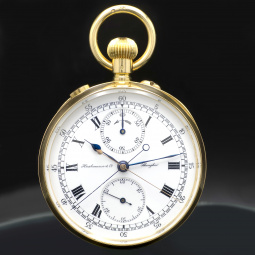
Longines Split-Seconds Chronograph Pocket Watch c.1910s — 24-Hour Dial, 30-Minute Register
ITEM-2769

Product Details
An exceptional example of early twentieth-century
Swiss precision watchmaking, this Longines split-seconds chronograph pocket
watch, dating to approximately the 1910s, features a sophisticated rattrapante
chronograph mechanism, a 30-minute register, and a distinctive 24-hour dial.
Housed in a substantial 54mm .900 silver open-face
case, this impressive timepiece combines the craftsmanship of Longines with the
technical complexity of one of traditional watchmaking's most fascinating
complications.
The split-seconds chronograph, also known by the
French term rattrapante, allows the measurement of intermediate times while the
primary chronograph continues running. This capability makes it considerably
more mechanically complex than a conventional chronograph.
The watch also incorporates a 30-minute chronograph
register, allowing elapsed minutes to be recorded during timing operations.
Details:
MAKE
Manufacturer: Longines
Complications: Split Second Chronograph, 30-Minute Register
Country: Switzerland
Type: Man’s
Serial #: 2863383
Circa Date: 1910s
CASE
Size: 54mm.
Style: Open Face.
Material: .900 Silver.
Decorations: Machined.
Dust Cover: Longines Universal Exhibitions Medals.
Conditions: C 3 (The
case is in Very Good condition)
DIAL
Color: White.
Type: Single sunk porcelain dial.
Numerals: Arabic Numerals.
Hands: Spade Hands.
Features: 24 Hour Dial
Conditions: D 3 (The dial is in Very Good condition)
MOVEMENT
Jewels: 20 Jewels.
Setting: Pin Set.
Escapement: Lever Escapement.
Material: Gilt.
Layout: ¾-Plate Layout.
Signed: Yes.
Conditions: M 3 (The movement is in Very Good
condition)
The Split-Seconds Chronograph
— A Sophisticated Timing Complication
The defining feature of this
Longines is its split-seconds
chronograph, also known as a rattrapante
chronograph.
A conventional chronograph
measures elapsed time using a centrally mounted chronograph seconds hand and,
when fitted, an elapsed-minute register.
A split-seconds chronograph
adds a second independently controllable chronograph seconds hand, allowing the
user to record intermediate times without stopping the primary chronograph.
When both hands are running
together, they generally appear to move as one.
Activating the split-seconds
mechanism temporarily stops one hand, allowing an intermediate time to be read
while the primary chronograph continues operating.
When the split-seconds
mechanism is released, the stopped hand rapidly catches up with the primary
chronograph hand.
This action gives the
complication its French name, rattrapante,
meaning to catch up.
The additional mechanical
components required to control the two chronograph hands make split-seconds
movements substantially more complex than ordinary chronographs.
For collectors of vintage
mechanical watches, this complication represents an important achievement in
precision timing technology.
30-Minute Chronograph Register
In addition to its
split-seconds mechanism, this Longines features a 30-minute chronograph register.
The register records
accumulated elapsed minutes during chronograph operation, extending the watch's
timing capability beyond the central chronograph seconds indication.
This combination of a
split-seconds mechanism and minute register provides a sophisticated
arrangement for measuring elapsed time and intermediate intervals.
Such functions were
particularly useful in sporting, scientific, and other applications requiring
careful timing.
Distinctive 24-Hour Dial
The watch features a beautiful white single-sunk porcelain dial
with Arabic numerals, traditional spade hands, and a 24-hour indication.
The 24-hour display is a
particularly interesting feature, allowing the time to be interpreted in a
full-day format rather than relying exclusively on a conventional 12-hour
indication.
This type of display is
associated with applications where distinguishing between morning and evening
hours can be useful.
The traditional porcelain dial
complements the technical complexity of the chronograph movement while
preserving the refined appearance of an early twentieth-century Swiss pocket
watch.
Longines and the Development
of Precision Chronographs
Founded in Saint-Imier,
Switzerland, in 1832, Longines developed an important reputation for precision
timekeeping and chronograph manufacture.
During the late nineteenth and
early twentieth centuries, the company produced chronographs and specialized
timing instruments for sporting, scientific, and professional applications.
Longines became particularly
associated with precision timing, developing movements and instruments that
contributed to the evolution of mechanical chronography.
This circa-1910s split-seconds
pocket watch reflects the company's expertise in complicated mechanical timing
instruments.
Its combination of a
rattrapante mechanism, elapsed-minute register, and 24-hour dial makes it a
particularly interesting example of the technical capabilities available during
the early twentieth century.
Longines Universal Exhibitions
Medals
Universal Exhibitions were
World's fairs originating in the French tradition of national exhibitions, a
tradition that culminated with the French Industrial Exposition of 1844 held in
Paris. This fair was soon followed by
other national exhibitions in continental Europe, and eventually the United
Kingdom. Many of the dust covers on the
Longines Pocket Watches from the 1900s exhibit the Universal Exhibitions Awards
Medals. Longines won a record of ten Grand Prix and 28 Gold Medals, more than
any other watch manufacturer! These include 1885 Grand Prix in Antqerp; 1897 in
Brussels; 1889, 1900 & 1925 in Paris; 1906 in Milan; 1914 in Genoa; 1914 in
Philadelphia; and 1926 & 1929 in Barcelona.
A Collectible Early Longines
Complicated Pocket Watch
Dating to approximately the 1910s,
this Longines represents an era when Swiss watchmakers were producing
increasingly sophisticated mechanical chronographs.
The combination of a split-seconds
chronograph, 30-minute register, 24-hour dial, 20-jewel movement, and .900
silver case gives this watch considerable technical and
historical interest.