
The Butterfly Cutout Pocket Watch Movement
An American Watchmaking Innovation of 1866
Among the more distinctive achievements of nineteenth-century American horology is the Butterfly Cutout pocket watch movement, an ingenious design combining mechanical functionality with decorative craftsmanship. Patented by Frederick A. Giles on March 13, 1866, this unusual movement became a recognizable feature of early watches produced by the United States Watch Company of Marion, New Jersey.
Manufactured during the years following the American Civil War, these watches represent an important chapter in the development of precision watchmaking in the United States. Today, surviving examples are admired by collectors for their innovative construction, elaborate movement finishing, and historical significance.
History of the Butterfly Cutout Movement
On March 13, 1866, inventor Frederick A. Giles received U.S. Design Patent No. 2,281 for a distinctive watch movement plate design. The patented arrangement incorporated an opening resembling two opposing crescents, creating the characteristic butterfly shape.
The United States Watch Company incorporated this design into its early 18-size, full-plate pocket watch movements. The company began manufacturing watches in Marion, New Jersey, in June 1867.
The period was one of considerable change in American industry. Precision manufacturing, interchangeable parts, and mechanized production were transforming the American watch industry and allowing domestic manufacturers to compete with established European watchmakers.
What Makes the Butterfly Cutout Unique?
In conventional full-plate pocket watch movements, much of the escapement mechanism is concealed beneath the upper movement plate. The Giles design introduced a carefully shaped opening exposing portions of the escape wheel and lever escapement.
This permitted watchmakers to observe the action of these important components while the movement was running, assisting with inspection and adjustment.
The cutout also provided a visually striking feature, allowing observers to appreciate the rhythmic operation of the watch's escapement.
Mechanical and Decorative Advantages
- Escapement visibility: Portions of the lever and escape wheel could be observed without removing the upper plate.
- Watchmaking utility: The opening facilitated visual examination of escapement operation.
- Distinctive appearance: The symmetrical double-crescent design created the unusual butterfly-shaped opening.
- Historical importance: The patented design represents an inventive approach to nineteenth-century American movement construction.
Unlike a fully skeletonized watch movement, which exposes extensive portions of the internal mechanism, the butterfly cutout concentrated attention on a specific mechanical assembly.
The United States Watch Company of Marion, New Jersey
Established during the formative years of American industrial watchmaking, the United States Watch Company began production in Marion in 1867. Its early movements are particularly interesting for their unusual engineering, decorative finishing, and distinctive mechanical designs.
The butterfly cutout became an identifying feature of the company's early full-plate movements, appearing in several grades, including the Frederic Atherton, George Channing, and John W. Lewis.
Many early Marion movements featured gilt-finished plates, ornamental engraving, and traditional nineteenth-century movement architecture. These characteristics distinguish them from the more standardized American movements that became common later in the century.
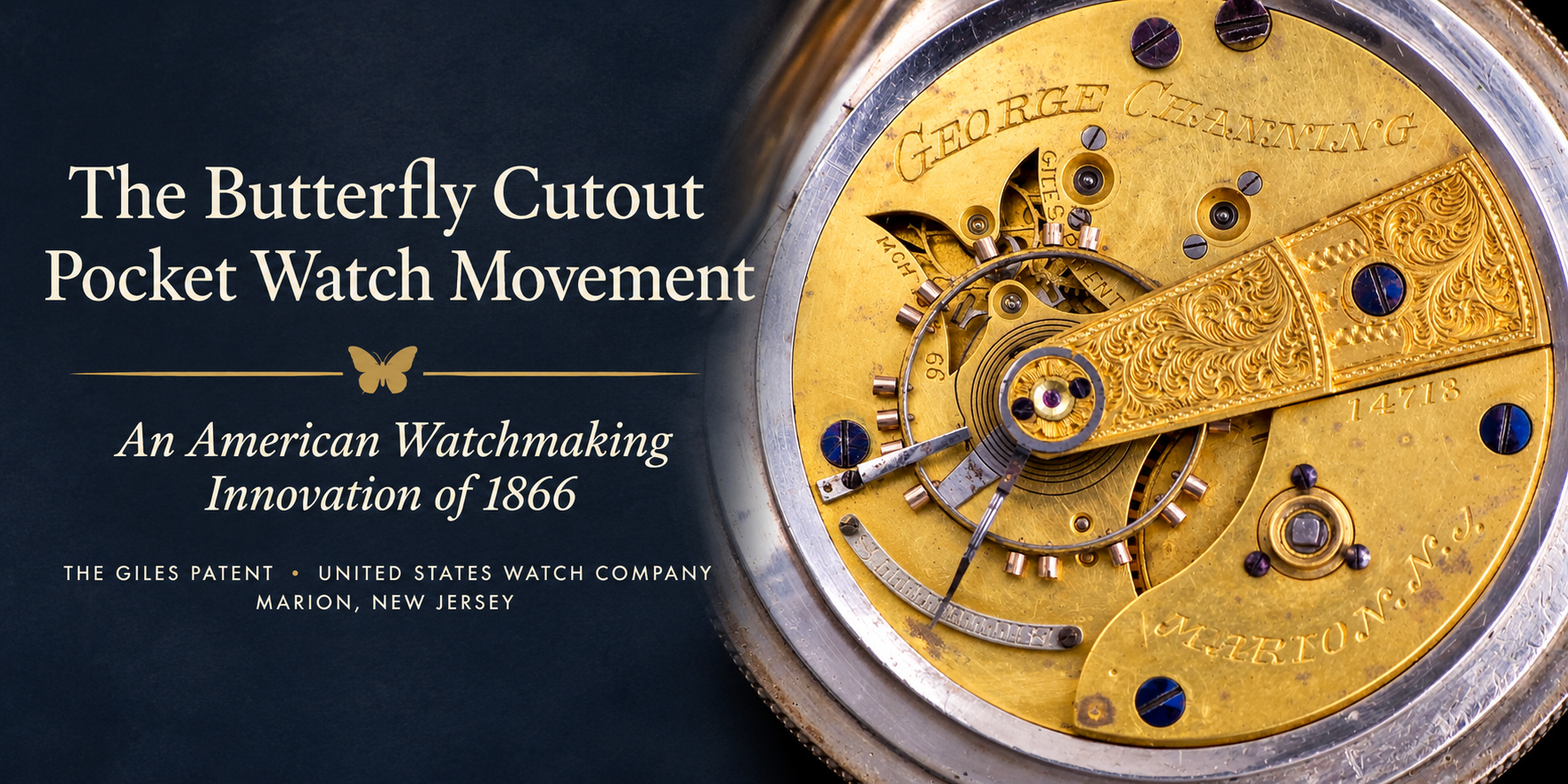
An Early George Channing Example, Circa 1868
An example from the Ashland Watches collection illustrates the craftsmanship of these early butterfly-cutout movements.
This George Channing pocket watch movement, serial number 14,713, is attributed to the United States Watch Company and dates to approximately 1868.
Its ornate engraved balance bridge, gilt movement plates, and distinctive opening above the escapement demonstrate the combination of artistic finishing and mechanical ingenuity characteristic of early Marion watchmaking.
As an example from the American Reconstruction period, this movement provides a tangible connection to the early development of America's precision watchmaking industry.
View an Original Butterfly Cutout Pocket Watch
Explore our George Channing Butterfly Cutout Pocket Watch, circa 1868, featuring the patented Giles movement, elaborately engraved gilt plates, and distinctive escapement opening.
The Butterfly Cutout and the Reconstruction Era
The American Reconstruction era extended from 1865 to 1877, following the end of the Civil War. This period witnessed significant industrial expansion and technological innovation throughout the United States.
The Giles butterfly design, patented in 1866 and used in watches manufactured beginning in the late 1860s, belongs directly to this period of American industrial development.
Although these watches are sometimes associated with Civil War-era collecting, examples manufactured around 1868 are more accurately described as Reconstruction-era American pocket watches.
Rarity and Collectibility
The butterfly-cutout movement occupies a special place among early American pocket watches. Its appeal extends beyond its unusual appearance to include the history of the Giles patent and the United States Watch Company's early manufacturing achievements.
Collectors evaluating these watches consider several important factors:
- Movement grade and manufacturing date
- Originality of the dial, hands, and case
- Condition of the gilt finish and engraving
- Mechanical condition and completeness
- Historical significance and provenance
The presence of a butterfly cutout alone does not establish rarity. Individual grade, configuration, condition, and surviving population must also be considered.
A Lasting Contribution to American Horology
More than 150 years after its introduction, the butterfly-cutout movement remains an appealing example of American watchmaking innovation.
Frederick A. Giles's patented design offered a practical means of observing the escapement while creating one of the most recognizable visual features of early American pocket watch construction.
For historians, watchmakers, and collectors, these movements preserve an important example of the ingenuity and craftsmanship that characterized the developing American watch industry.
Historical References and Further Reading
- The Patented Butterfly Cutout Escapement Watch Plate Design by Frederick A. Giles — Pocket Watch Database.
- Frederick A. Giles, U.S. Design Patent No. 2,281, Watch Plate, March 13, 1866.
- William Muir and Bernard Kraus, Marion: A History of the United States Watch Company, 1985.