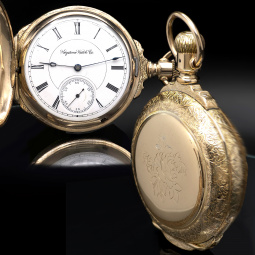
Rare George Channing Butterfly Cutout Pocket Watch c.1868 | Giles Patent | Reconstruction Era
ITEM-2757-EA

Product Details
An impressive example of early American watchmaking, this U.S. Watch Co. George Channing Grade pocket watch, dating to approximately 1868, features a substantial 18 Size coin silver hunter case, a signed 15-jewel gilt full-plate movement, and a beautiful white single-sunk porcelain dial.
Dating to the years immediately
following the American Civil War, this handsome timepiece represents an
important period in the development of American watch manufacturing, when
companies were refining the techniques that would eventually make the United
States a world leader in the production of mechanical watches.
Learn more about the history of the Butterfly Cutout Pocket Watch Movement -- >
Details:
MAKE
Manufacturer: U.S. Watch Co.
Model: George Channing Grade
Country: USA
Type: Man’s
Serial #: 14718
Circa Date: 1868
CASE
Size: 18 Size.
Style: Hunter Case.
Material: Coin Silver.
Decorations: Engraved
Floral Design.
Weighs: 3-1/2 OZ
Conditions: C 3 (The
case is in Very Good condition)
DIAL
Color: White.
Type: Single Sunk Porcelain Dial.
Numerals: Roman Numerals.
Hands: Spade Hands.
Conditions: D 3 (The dial is in Very Good condition)
MOVEMENT
Jewels: 15 Jewels.
Setting: Key Set Set. A correctly sized, newer replacement key is included
with the watch. Although the key is not original to this timepiece, it is
appropriately sized for its winding and setting mechanisms.
Escapement: Lever Escapement.
Material: Gilt.
Layout: Full Plate Layout.
Signed: Yes.
Conditions: M 3 (The movement is in Very Good
condition)
Its
combination of historical significance, decorative craftsmanship, and
traditional key-operated mechanical construction makes it an appealing addition
to a collection of nineteenth-century American horology.
The Butterfly Cutout pocket
watch movement, circa 1868, is a particularly interesting piece of early
American watchmaking history. It is closely associated with the United States
Watch Company of Marion, New Jersey, and a distinctive patented movement design
by Frederick A. Giles.
For collectors of
nineteenth-century American watches, the butterfly cutout is both an attractive
mechanical feature and an important example of innovation during the years
immediately following the Civil War.
1. The history of the
Butterfly Cutout movement
Patented: March 13, 1866
Inventor: Frederick A. Giles
Manufacturer: United States
Watch Company, Marion, New Jersey
Period: American Reconstruction
era, 1865–1877
Typical movement size: 18 size
Distinctive feature:
Butterfly-shaped opening in the movement's top plate exposing the escapement.
Giles received a design patent,
U.S. Design Patent No. 2,281, for this unusual configuration. His design
incorporated two opposing crescent-shaped openings, producing the appearance of
a butterfly.
This was not merely decorative.
The cutout permitted watchmakers to observe the operation of the escapement
without removing the top plate, making inspection and adjustment more
convenient.
The design became one of the
distinguishing characteristics of early United States Watch Company movements
and remains highly recognizable to American pocket-watch collectors.
Pocket Watch
Database Blog+1
Why the butterfly design was
important
Most American full-plate
pocket-watch movements of the 1860s concealed much of the escapement beneath
the upper movement plate.
The Giles design departed from
that convention by creating an opening through which portions of the escapement
could be seen operating.
Its advantages included:
·
Visibility:
The lever and escape wheel could be observed during operation.
·
Watchmaking
utility: The opening made examination of escapement action easier.
·
Distinctive
appearance: The graceful cutout gave the movement an immediately identifiable
character.
·
Historical
significance: It demonstrated an inventive approach to American watch movement
construction during the industry's early development.
The butterfly opening should
not be confused with a fully skeletonized watch movement. It exposed a
particular mechanical assembly rather than extensively removing material
throughout the movement.
Pocket Watch
Database Blog
Connection to the
Reconstruction period
The dating of approximately
1868 is especially significant.
The Civil War ended in 1865,
and the American Reconstruction period extended from 1865 to 1877. These
watches were products of an era when American manufacturers were developing
increasingly sophisticated domestic watchmaking technology.
According to a historical
review published by the American Watchmakers-Clockmakers Institute, production
at the United States Watch Company began in June 1867. Therefore, a movement
made around 1868 would belong to the company's very early manufacturing period.
One important distinction: a
watch made in 1868 is properly described as a Reconstruction-era pocket watch,
not a Civil War-era watch. Its design patent dates from 1866, after the war.
George Channing Grade — Early
American Watchmaking
The George Channing Grade is an
especially interesting feature of this early U.S. Watch Co. pocket watch.
During the nineteenth century,
American watch manufacturers frequently assigned distinctive names to their
movement grades. These names helped distinguish different levels of
construction and quality within a company's product line.
The George Channing designation
provides an important identifying characteristic for collectors researching
early American watch production.
This example, with its 15-jewel
movement and serial number 14,718, reflects the traditional mechanical
construction of the late 1860s.
The early production period,
combined with its named grade, makes it particularly appealing to enthusiasts
of nineteenth-century American watchmaking.
Substantial 3½-Ounce Coin
Silver Hunter Case
One of the most desirable
features of this watch is its impressive coin silver hunting case, decorated
with an attractive engraved floral pattern.
Coin silver was commonly used
in American watch cases during the nineteenth century. Traditionally associated
with a silver content of approximately 90%, coin silver offered an attractive
precious-metal alternative to gold cases.
The case is cataloged as
weighing 3½ ounces, giving it a substantial presence.
Its engraved floral decoration
reflects the ornate styling popular during the Victorian era, when pocket-watch
cases were frequently embellished with scrollwork, floral motifs, and other
decorative patterns.
The hunter-style construction
incorporates a protective front cover, allowing the dial to remain enclosed
when the watch is not being read.
The case remains in C3 – Very
Good condition.
White Single-Sunk Porcelain
Dial
The watch features a
traditional white single-sunk porcelain dial with Roman numerals and spade
hands.
Single-sunk construction
provides a recessed section, typically for the subsidiary seconds register,
creating additional depth in the dial.
The Roman numerals are
particularly appropriate to the watch's nineteenth-century character, giving it
a refined, classical appearance.
The combination of white
porcelain, traditional numerals, and spade hands creates an elegant contrast
with the engraved silver hunter case.
The dial remains in D3 – Very
Good condition.
15-Jewel Gilt Full-Plate
Movement
At the heart of this watch is a
signed 15-jewel U.S. Watch Co. George Channing Grade movement, serial number
14,718.
The movement features a
traditional gilt full-plate layout, characteristic of many early American
pocket watches.
Full-plate construction uses a
substantial upper plate to support the movement's mechanical components.
The gilt finish provides an
attractive appearance and reflects the manufacturing traditions of the period.
The movement incorporates a
lever escapement, which regulates the controlled release of energy through the
watch's gear train.
Its 15 jewels provide durable
bearing surfaces at selected friction points, helping reduce wear and support
reliable mechanical operation.
The movement remains in M3 –
Very Good condition.
Traditional Key-Wind and
Key-Set Construction
This circa-1868 U.S. Watch Co. George Channing pocket watch features the
traditional key-wind and key-set mechanism characteristic of
early American watchmaking.
Before stem winding became widespread, pocket watches required a separate
key to wind the mainspring and set the hands. This traditional construction is
an important part of the watch's nineteenth-century character.
A correctly sized, newer replacement key is included with the watch.
Although the key is not original to this timepiece, it is appropriately sized
for its winding and setting mechanisms.
An American Pocket Watch from
1868
The year 1868 places this watch
in the early Reconstruction period following the American Civil War.
The United States was
undergoing significant industrial and economic change, with expanding
railroads, growing manufacturing industries, and rapid advances in mechanical
production.
American watchmaking was
developing into a major industry, supported by improvements in machine tooling,
standardized components, and increasingly sophisticated manufacturing methods.
Pocket watches were essential
personal timekeepers during this period, serving businessmen, travelers,
tradesmen, and professionals.
This George Channing Grade
watch provides a tangible connection to that important era in American history.