
Antique Pocket Watch Terminology
This guide defines key terms used in antique pocket watches, railroad-grade timepieces, and vintage mechanical watch movements, including case styles, escapements, and collector terminology.
A | B | C | D | E | F | G | H | I | J | K | L | M | N | O | P | Q | R | S | T | U | V | W | X | Y | Z
A
(Top of Page)ADJUSTMENTS - ADJUSTED
The process of regulating a watch to maintain accurate timekeeping despite variations caused by position, temperature, or mainspring power. High-grade watches were often adjusted to multiple positions, temperature, and isochronism to improve accuracy. To learn more about watch adjustments, explore watch adjustments in mechanical timepieces.
ALARM WATCH
A watch that will give an audible sound at a pre-set time.
ALL OR NOTHING PIECE
A repeating Watch mechanism which ensures that ALL the hour & minutes are struck or sounded or nothing is heard.
ANALOGUE
A term used to denote a watch dial with hands rather than digital display.
ANNEALING
Heating and cooling a metal slowly to relieve internal stress.
ANTI-MAGNETIC
Not affected by magnetic field.
ANTIQUARIAN
Of antiques or dealing in, also the study of old and out-of-date items.
ARBOR
The mechanical axle of a moving part; on the balance it is called the staff, on the lever it is called the arbor.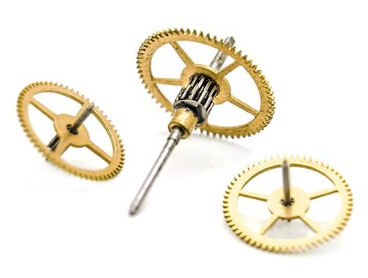
ASSAY
Analyzing a metal for its gold or silver content.
AUTOMATON
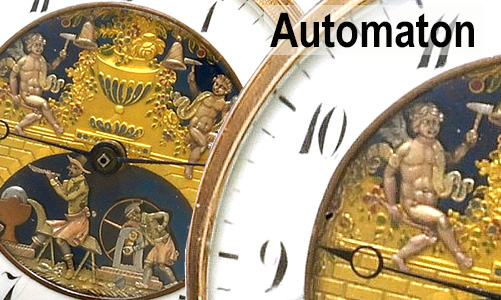
Automatic working figures moving in conjunction with the movement mechanism. Striking Jacquemarts or jacks which are figures (may be humans provided with hammers) striking bells to supply the sound for the hour & quarter hours. The hammers take the place of the bells clapper, Automata plural of automaton. View a previous sale of an iconic 5-motion automaton pocket watch.
AUXILIARY COMPENSATION
For middle temperature errors found on marine chronometers.
AUXILIARY DIAL
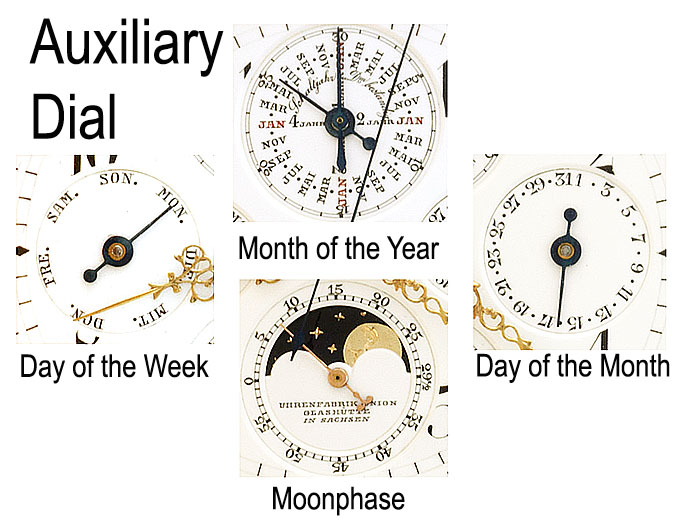
Any extra dial for information. View an excellent example of a complicated watch with auxiliary dials.
AWI
American Watchmakers-Clockmakers Institute, 701 Enterprise Drive Harrison, OH 45030. Tel # (513) 367-9800
B
(Top of Page)(BOX CASE) BREGUET KEY
A ratcheting watch key permitting winding in only one direction.
BAGUETTE
A French term for oblong shape. A watch having it's length at least 3 times it's width. A long narrow diamond.
BALANCE COCK
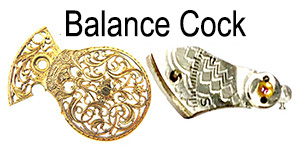
The bridge that holds the upper jewels and the balance and secured at one end only.
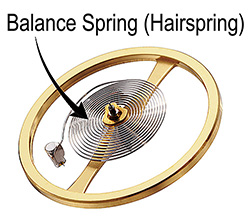
BALANCE SPRING
Also called the hairspring; the spring governing the balance.
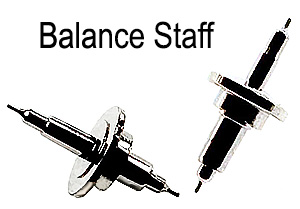
BALANCE STAFF
The shaft of the balance wheel.
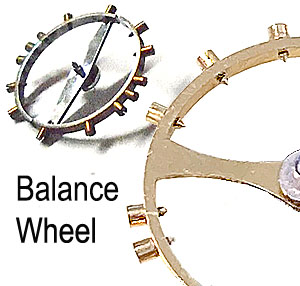
BALANCE WHEEL
A device shaped like a wheel that does for a watch what a pendulum does for a clock.
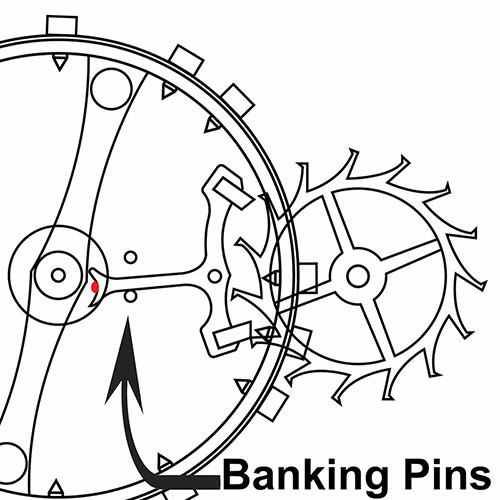
BANKING PINS
The two pins that limit the angular motion of the pallet.
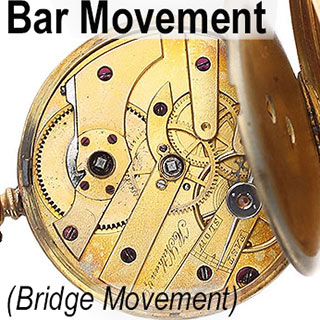
BAR MOVEMENT (Bridge Movement)
A type of movement employing about six bridges to hold the train. In use by 1840.
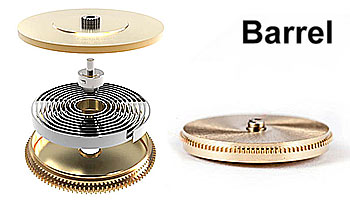
BARREL
Drum-shaped container that houses the mainspring.
BEAT
Refers to the tick or sound of a watch; about 1/5 of a second. The sound is produced by the escape wheel striking the pallets.
BEETLE HAND
Hour hand resembling a stag beetle; usually associated with the poker-type minute hand in 17th and 18th century watches.
BELL METAL
Four parts copper and one part tin used for metal laps to get a high polish on steel.
BEZEL
The rim that covers the dial (face) & retains the crystal. Above snap on bezel.
BI-METALLIC BALANCE
A balance composed of brass and steel designed to compensate for temperature changes in the hairspring.
BLIND MANS WATCH
A Braille watch; also known as a tact watch.
BLUING
By heating polished steel to 540 degrees the color will change to blue.
BOMBE
Convex on one side.
BOW
The ring that is looped at the pendant to which a chain or fob is attached
BOX CHRONOMETER
A marine or other type chronometer in gimbals so the movement remains level at sea.
BOX JOINTED CASE
A heavy hinged decorative case with a simulated joint at the top under the pendant.
BREGUET SPRING
A type of hairspring that improves time keeping also called over coil hairspring.
BRIDGE (See Bar Movement)
A metal bar which bear the pivot of wheels and is supported at both ends. (See cock.)
BUBBLE BACK
A Rolex wristwatch that was waterproof (Oyster) and auto wind (Perpetual) Ca. 1930 to 1950's.
BUFFER SPRING
Buffer spring is a stop spring for oscillating weight.
BULL'S EYE CRYSTAL
Used on old type watches; the center of the crystal was polished which achieved a bull's eye effect.
BUTTERFLY CUTOUT MOVEMENT
A distinctive American pocket watch movement featuring a butterfly-shaped opening in the upper movement plate that exposes portions of the escapement. Patented on March 13, 1866, by Frederick A. Giles, the design allowed watchmakers to observe the escapement in operation without removing the plate. Closely associated with early United States Watch Company movements manufactured in Marion, New Jersey, during the late 1860s, the butterfly cutout is recognized for its unusual appearance, mechanical ingenuity, and historical significance in American watchmaking. Learn more about the history of the Butterfly Cutout Pocket Watch Movement.
C
(Top of Page)CABOCHON
An unfaceted cut stone of domed form or style. (On some crowns)
CALIBRE
Size of a watch movement also to describe the model, style or shape of a watch movement.
CAP JEWEL
Also called the end stone, the flat jewel on which the staff rests.
CASE SCREW
A screw with part of the head cut away.
CENTER WHEEL
The second wheel; the arbor for the minute hand; this wheel makes one revolution per hour.
CHAIN
Looks like a miniature bicycle chain connecting the barrel and fusee.
CHAMFER
Sloping or beveled. Removing a sharp edge or edges of holes.
CHAMPLEVE
An area hollowed out and filled with enamel and then baked on.
CHAPTER
The hour, minute & seconds numbers on a dial. The chapter ring is the zone or circle that confines the numbers.
CHRONOGRAPH
A movement that can be started and stopped to measure short time intervals and return to zero. A stopwatch does not keep the time of day.
CHRONOMETER
A highly accurate watch that has been tested and certified to meet specific precision standards established by an official testing authority. What Is a Chronometer?
CHRONOMETER ESCAPEMENT
A detent escapement used in marine chronometers.
CIRCA
Approximately. (Ca.)
CLICK
A pawl that ratchets and permits the winding wheel to move in one direction; a clicking sound can be heard as the watch is wound.
CLOCK WATCH
A watch that strikes the hour but not on demand.
CLOISONNE
Enamel set between strips of metal and baked onto the dial.
CLUB TOOTH
Some escape wheels have a special design which increases the impulse plane; located at the tip of the tooth of the escape wheel
COARSE TRAIN
16,000 beats per hour.
COCK
The metal bar that carries the bearing for the balance's upper pivot and is supported at one end.
COMPENSATION BALANCE
A balance wheel designed to correct for temperature.
COMPLICATED WATCH
Any function in a watch beyond the basic display of hours and minutes, such as a date display, chronograph, moon phase, alarm, or perpetual calendar. Watches featuring multiple advanced functions are often referred to as Grand Complications. Learn more about watch complications.
CONTRATE WHEEL
A wheel with its teeth at a right angle to plane of the wheel.
CONVERTIBLE
Movement made by Elgin & other companies; a means of converting from a hunting case to a open-face watch or vice versa.
CRAZE
A minute crack in the glaze of enamel watch dials.
CROWN
A winding button.
CROWN WHEEL
The escape wheel of a verge escapement; looks like a crown. Also the lower illustration shows a crown wheel used in a stem winding pocket watch.
CURB PINS
The two pins that change the rate of a watch; the two pins, in effect, change the length of the hairspring.
CUVETTE
The inter dust cover of a pocket watch.
CYLINDER ESCAPEMENT
A type of escapement used on some watches.
D
(Top of Page)DAMASKEENING
The art of producing a design, pattern, or wavy appearance on a metal. American idiom or terminology used in all American factory ads. The European terminology was Fausse Cotes or Geneva stripes.
DEMI-HUNTER
A hunting case with the center designed to allow the position of the hands to be seen without opening the case.
DETENT ESCAPEMENT
A detached escapement. The balance is impulsed in one direction; used on watches to provide greater accuracy. Detent a locking device.
DIAL
The face of a watch. Some are made of enamel.
DISCHARGE PALLET JEWEL
The right or 2nd jewel on lever. The 2nd of two pallet jewels with which a tooth of the escape wheel comes into engagement. Also called the Exit pallet.
DOUBLE ROLLER
A watch with one impulse roller table and a safety roller, thus two rollers.
DRAW
The angular position of the pallet jewels in the pallet frame which causes those jewels to be drawn deeper into the escape wheel under pressure of the escape wheel's tooth on the locking surface.
DROP
The space between a tooth of the escape wheel and the pallet from which it has just escaped.
DUMB-REPEATER
A repeating watch with hammers that strikes a block instead of bells or gongs.
DUPLEX ESCAPEMENT
An escape wheel with two sets of teeth, one for locking and, one for impulse. An escape wheel with two sets of teeth, one for locking and one for impulse. The duplex escapement was invented by Jean Baptiste Dutertre in 1724. The advantage of these escapements was that they only gave the balance wheel a short push in the middle of its swing, leaving it 'detached' from the escapement to swing back and forth undisturbed during most of its cycle.
DUST COVER
Usually used on fusee movements, the dust cover adds an extra layer of protection for the movement within the case. The cover has a crescent shaped slide spring catch holding it in place. To remove the dust cover, in the center find a pin and with your thumbnail slide the catch to the right or left. After you have moved the slide you can now lift the dust cover up to expose the movement.
E
(Top of Page)EBAUCHE
A movement not completely finished or in the rough; not detailed; a raw movement; a movement made up of two plates, train, barrel & did not include a dial, case, or escapement.
ECCENTRIC
Not exactly circular, Non-concentric. A cam with a lobe or egg shape.
ELECTRONIC WATCH
Newer type watch using quartz and electronics to produce a high degree of accuracy.
ELINVAR
A hairspring composed of a special alloy of nickel, steel, chromium, manganese and tungsten that does not vary at different temperatures. Elinvar was derived from the words elasticity invariable.
END SHAKE
The up and down play of an arbor between the plates and bridge or between the jewels.
END STONE
The jewel or cap at the end of the staff.
ENGINE TURNING
Engraving a watch case with a repetitive design by a machine.
EPHEMEROUS TIME
The time calculated for the Earth to orbit around the sun.
ESCAPE WHEEL
The last wheel in a going train; works with the fork or lever and escapes one pulse at a time.
ESCAPEMENT
The device in a watch by which the motion of the train is checked and the energy of the mainspring communicated to the balance. The escapement includes the escape wheel, lever, and balance complete with hairspring. View detailed watch escapement diagrams and explanations of historic escapement types.
EXPOSED BALANCE - 8 DAY WATCHES
These popular timepieces featured fancy colored dials with an opening at the bottom of the dial to expose the balance wheel and pallet-fork. 8 Days refers to how long the watch would theoretically run when fully wound.
F
(Top of Page)FARMER' S WATCH
A large pocket watch with a verge escapement and a farm scene on the dial.
FECIT
A Latin word meaning "made by".
FERGUSON DIAL
One railroad watch dial design was patented by a Mr. Ferguson. On this dial, the five minute numbers were much larger than the hour numbers which were on the inside.
FIVE-MINUTE REPEATER
A watch that denotes the time every five minutes, and on the hour and half hour, by operating a push piece.
FLINQUE
Enameling over hand engraving.
FLY BACK
The hand returns back to zero on a timer.
FOB
A decorative short strap or chain.
FOLIOT
A straight-armed balance with weights on each end used for regulation; found on the earliest clocks and watches.
FORK
The part of the pallet lever that engages with the roller jewel.
FREE SPRUNG
A balance spring free from the influence of a regulator.
FULL PLATE
A plate (or disc) that covers the works and supports the wheels pivots. There is a top plate, a bottom plate, half, and 3/4 plate. The top plate has the balance resting on it.
FUSEE
A spiral grooved, truncated cone used in some watches to equalize the power of the mainspring. Learn more about Fusee Pocket Watches
G
(Top of Page)GOING BARREL
The barrel houses the mainspring; as the spring uncoils, the barrel turns, and the teeth on the outside of the barrel turn the train of gears as opposed to toothless fusee barrel.
GENEVA STOP WORK
A system used to stop the works preventing the barrel from being over wound.
GILT (OR GILD)
To coat or plating with gold leaf or a gold color.
GOLD JEWEL SETTINGS
In high-grade watches the jewels were mounted in gold settings.
GOLD-FILLED
Sandwich-type metal; a layer of gold, a layer of base metal in the middle, another layer of gold-then the layers of metals are soldered to each other to form a sandwich.
GRANDE SONNERIE
A watch or clock that strikes the hour, 1/4 hours and minutes; if minute repeater, a Petite Sonnerie strikes hour only.
GREAT WHEEL
The main wheel of a fusee type watch.
GUILLOCHE
A decorative pattern of cross or interlaced lines. (Engraving style)
H
(Top of Page)HACK-WATCH
A watch with a balance that can be stopped to allow synchronization with another timepiece.
HAIRSPRING
The spring that vibrates the balance. Also called balance spring.
HAIRSPRING STUD
A hairspring stud is used to connect the hairspring to the balance cock.
HALLMARK
The silver or gold or platinum markings of many countries.
HEART CAM-PIECE
A heart-shaped cam which causes the hand on a chronograph to fly back to zero.
HELICAL HAIRSPRING
A cylindrical spring used in chronometers
HOROLOGY
The study of time keeping.
HUNTER CASE
A pocket watch case with a covered face that must be opened to see the watch dial. Discover how hunting case pocket watches work and why they were used.
I
(Top of Page)IMPULSE
The force transmitted by the escape wheel to the pallet by gliding over the angular or impulse face of the pallet jewel.
IMPULSE PIN
(Ruby pin)(roller jewel)-A pin or jewel on the balance roller table that keeps the balance going.
INCABLOC
A patented shock-absorbing device that permits the end stone of the balance to give when the watch is subjected to an impact or jolt. First used in 1933.
INDEPENDENT SECONDS
A seconds hand driven independently by a separate train but controlled by the time train.
INDEX
Another term for the racquet shaped regulator, which lengthens or shortens the effective length of the hairspring.
ISOCHRONISM
"Isos" means equal; "chronos" means time- occurring at equal intervals of time. The balance and hairspring adjusted will allow the watch to run at the same rate regardless whether the watch fully wound or almost run down.
J
(Top of Page)JEWEL
The number of jewels used within a watch movement to reduce friction, minimize wear, and improve long-term performance. A bearing made of a ruby or other type jewel; the four types of jewels include; cap jewel, hole jewel, roller jewel or ruby pin, pallet jewel or stone. Pocket Watch Jewel Count Explained.
K
(Top of Page)KARRUSEL
An invention of Bonniksen in 1894 which allows the entire escapement to revolve within the watch once in 52 1/2 minutes (in most karrusels), this unit is supported at one end only as opposed to the tourbillon which is supported at both ends and which most often revolves about once a minute.
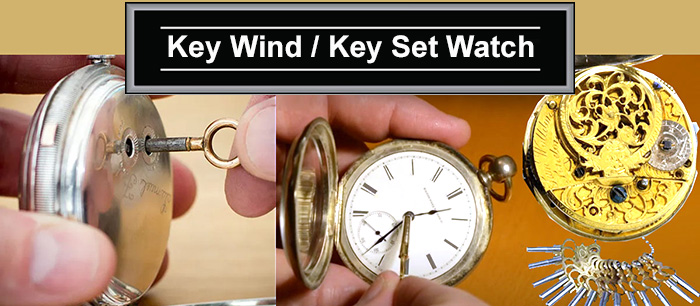
KEY WIND / KEY SET
The very first pocket watches up until the third quarter of the 19th century had key-wind and key-set movements. A watch key was necessary to wind the watch and to set the time. This was usually done by opening the case back and putting the key over the winding-arbor (which was set over the watch's winding-wheel, to wind the mainspring) or by putting the key onto the setting-arbor, which was connected with the minute-wheel and turned the hands. Some watches of this period had the setting-arbor at the front of the watch, so that removing the crystal and bezel was necessary to set the time. View examples of antique key wind pocket watches.
L
(Top of Page)L'EPINE' CALIBRE
Introduced by J.A. L'Epine about 1770. Swiss for open face.
LEAVES
The teeth of the pinion gears.
LEVER ESCAPEMENT
Invented by Thomas Mudge in about 1759
LEVER SET - LEVER SETTING
A lever-set watch is a type of pocket watch that requires a small metal lever to be moved before the crown can be used to set the time. This design was popularized in the 19th century, especially for railroad-grade pocket watches, to prevent accidental time changes that could cause dangerous delays. Learn how a lever set pocket watch works.
LOCKING
Arresting the advance of the escape wheel during the balance's free excursion.
LUGS
The metal extensions of a wrist watch case which the bracelet or band are attached usually with a spring bar.
M
(Top of Page)MAIN SPRING
A flat spring coiled or wound to supply power to the watch. The non-magnetic mainspring, introduced 1947.
MAIN WHEEL
The first driving wheel, part of the barrel.
MALTESE CROSS
The part of the stop works preventing the barrel from being over wound.
MARINE CHRONOMETER
An accurate timepiece; may have a detent escapement and set in a box with gimbals which keep it in a right position.
MEAN TIME
Also equal hours; average mean solar time; the time shown by watches.
MEANTIME SCREWS
Balance screws used for timing, usually longer than other balance screws; when turned away from or toward the balance pin, they cause the balance vibrations to become faster or slower.
MICRO-SECOND
A millionth of a second.
MICROMETRIC REGULATOR
A regulator used on railroad grade watches to adjust for gain or loss in a very precise way.
MINUTE REPEATER
A watch that strikes or sounds the hours and minutes on demand.
MOVEMENT
The works of a mechanical watch without the case or dial. (quartz watches have modules)
MULTI-COLOR
(Gold) Different colors of gold-red, green, white, blue, pink, yellow and purple.
MUSICAL WATCH
A watch that plays a tune on demand or on the hour.
N
(Top of Page)N. A. W. C. C.
National Association of Watch and Clock Collectors 514 Poplar St. Columbia, Pa. 17512. TEL. 1-717-684-8261
NANOSECOND
One billionth of a second.
NURENBURG EGG
Nickname for a German watch that was oval-shaped.
O
(Top of Page)OIGNON
Large older (1675) style watch in the shape of a onion or in the shape of a bulb. Learn more about Oignon and Pair Case pocket watch cases →
OIL SINK
A small well around a pivot which retains oil.
OPEN FACE
A pocket watch case design with no hinged front cover, leaving the crystal and dial fully exposed for immediate time reading. Open face watches became the preferred style for railroad service due to their quick readability and practicality in time-sensitive environments. Understanding Open Face Pocket Watches.
OVERBANKED
A lever escapement error; the roller jewel passes to the wrong side of the lever notch, causing one side of the pallet to rest against the banking pin and the roller jewel to rest against the other side, thus locking the escapement and stopping the motion of the balance.
OVERCOIL
The raised up portion of the balance hairspring, not flat. Also called Breguet hairspring
OVERSIZED
Oversized refers to a pocket watch that is larger than the standard size commonly encountered for its type or era. In our listings, the term is generally used for watches measuring 50mm or larger in diameter, often including 18-size pocket watches and other large-format cases.
P
(Top of Page) <PAIR-CASE WATCH
An extra case around a watch-two cases, hence, a pair of cases. The outer case kept out the dust. The inner case could not be dustproof because it provided the access to the winding and setting keyholes in the watch case. Learn more about Pair and Oignon Case pocket watch cases →
PALLADIUM
One of six platinum metals, used in watches in place of platinum, because it is harder, lighter and cheaper.
PALLET
The part of the lever that works with the escape wheel-jeweled pallet jewels, entry and exit pallets.
PARACHUTE
An early shock proofing system designed to fit as a spring on the end stone of balance.
PATINA
Oxidation of any surface & change due to age. A natural staining or discoloration due to aging.
PAVE'
A number of jewels or stone set close together. Paved in diamonds.
PENDANT
The neck of the watch; attached to it is the bow (swing ring) and the crown.
PENDANT SET
A pocket watch setting system where the crown is pulled outward to engage the hand-setting mechanism, commonly used on non-lever-set watches. Learn more about Pendant Set Pocket Watches.
PILLARS
The rods that hold the plates apart. In older watches they were fancy.
PIN SET
The method of setting a pocket watch in which a small pin or button near the pendant is pressed and held while the crown is turned to adjust the hands. Also sometimes called nail set. Learn more about Pin Set Pocket Watches.
PINCHBECK
A metal similar in appearance to gold. Named after the inventor. Alloy of 4 parts copper & 3 parts zinc.
PINION
The larger gear is called a wheel. The small solid gear is a pinion. The pinion is made of steel in some watches.
PLATE
A watch has a front and a back plate or top and bottom plate. The works are in between.
POISE
A term meaning in balance to equalize the weight around the balance.
PONTILLAGE
(bull's eye crystal)- The grinding of the center of a crystal to form a concave or so-called bull's eye crystal.
POSITION
As adjusted to five positions; a watch may differ in its time keeping accuracy as it lays in different positions. Due to the lack of poise, changes in the center of gravity, a watch can be adjusted to six positions: dial up, dial down, stem up, stem down, stem left, and stem right. Note: Adj. to 5 positions is also 8 adjustments.
Q
(Top of Page)QUICK TRAIN
A watch with five beats or more per second or 18,000 per hour.
R
(Top of Page)RACK & PINION LEVER ESCAPEMENT
Developed by Abbe de Huteville in 1722 and by Peter Litherhead in 1791; does not use a roller table, but a pinion.
RECEIVING PALLET
Also called left or entrance jewel, the first of two pallet jewels with which a tooth of the escape wheel comes into engagement.
REPEATER WATCH
A complicated watch that repeats the time on demand with a sounding device.
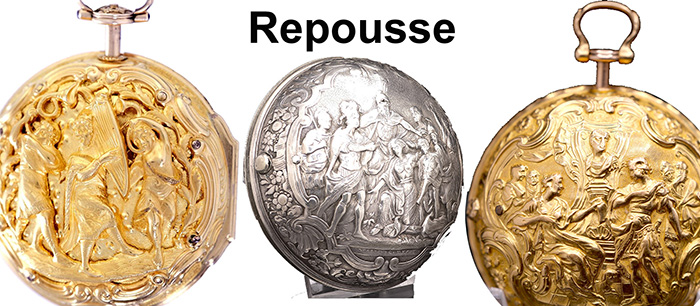
REPOUSSE' or REPOUSSAGE
Repousse is a metalworking technique in which a malleable metal is ornamented or shaped by hammering from the reverse side to create a design in low relief. It is also known as embossing. View an Antique Repoussé Pocket Watch.
RIGHT ANGLE LEVER ESCAPEMENT
Also called English escapement.
ROLLED GOLD
Thin layer of gold soldered to a base metal.
ROLLER JEWEL
The jewel mounted or seated in the roller table, which receives the impulse from the pallet fork.
ROLLER TABLE
The part of the balance in which the roller jewel is seated.
ROTOR
Oscillating weight for self-wind watches.
S
(Top of Page)SAFETY PINION
A pinion in the center wheel designed to unscrew if the mainspring breaks; this protects the train from being stripped by the great force of the mainspring
SAFETY ROLLER
The smaller of the two rollers in a double roller escapement.
SAPPHIRE CRYSTAL
Scratch resistant glass with a hardness of 9. Mineral glass has a hardness of 5.
SHAGREEN
The skin of a horse, shark, ray fish & other animal usually dyed GREEN or a BLUE GREEN. Then used as ornamental covers for older watchcases.
SIDE-WINDER
A mismatched case and movement; a term used for a hunting movement that has been placed in an open face case and winds at 3 o'clock position. Open face winds at 12 o'clock.
SIDEREAL DAY
The time of rotation of the Earth as measured from the stars. About 3 minutes 56 seconds shorter than the mean solar day.
SILVEROID
A type of case composed of alloys to simulate the appearance of silver.
SINGLE HAND WATCH
1600–1675 — Most watches still had one hand. Early verge fusee watches commonly displayed only the hour. Their mechanical accuracy often made precise minute indications unnecessary.
SINGLE ROLLER
The safety roller and the roller jewel are one single table.
60-MINUTE CHRONOGRAPH REGISTER
A subdial on a chronograph that records elapsed minutes, typically up to 60 minutes, while the chronograph is running. It works in conjunction with the chronograph seconds hand to measure longer time intervals.
SIZE
Pocket watch case sizes are traditionally measured using the American watch sizing system. While actual dimensions can vary slightly by manufacturer and case style, the following are common size ranges:
- 10–12 Size – Approximately 40–44mm in diameter. Smaller pocket watches often carried by gentlemen and ladies.
- 16 Size – Approximately 45–49mm in diameter. The most common size for American railroad-grade pocket watches.
- 18 Size – Approximately 50–55mm in diameter. Large pocket watches popular during the late 19th century and favored for their substantial presence and readability.
Measurements refer to the case diameter excluding the crown and bow.
SKELETON WATCH
A watch made so the viewer can see the works. Plates are pierced and very decorative.
SKULL WATCH
A antique pendant watch that is hinged at jaw to reveal watch.
SLOW TRAIN
A watch with four beats per second or 14,000 per hour.
SNAIL
A cam shaped much like a snail. The snail determines the # of blows to be struck by a repeater. (A count wheel)
SNAILING
Ornamentation of the surface of metals by means of a circle design; also called damaskeening.
SOLAR YEAR
365 days, 5 hours, 48 minutes, 49.7 seconds.
SOUSCRIPTION
A distinctive single-hand pocket watch introduced by Abraham-Louis Breguet in 1796. The French term souscription refers to the subscription sales arrangement requiring a 25% deposit before manufacture. Typically measuring approximately 61 mm, these watches featured large enamel dials, a single central hand, and simplified movements with centrally positioned mainspring barrels. Approximately 700 were produced. The Souscription represents an important combination of technical innovation and commercial ingenuity in late eighteenth-century French watchmaking.
SPLIT-SECONDS CHRONOGRAPH
A chronograph with two superimposed seconds hands that can time two events starting at the same time. One hand can be stopped independently to record an intermediate or split time while the other continues running, then released to catch up with the moving hand. Also called a rattrapante chronograph.
SPOTTING
Decoration used on a watch movement and barrel of movements.
SPRING BAR
The metal keeper that attaches The band to The lugs of a wrist watch & is spring loaded.
SPRING RING
A circular tube housing a coiled type spring.
STACKFREED
Curved spring and cam to equalize the uneven force of the mainspring on 16th century German movements.
STAFF
Name for the axle of the balance.
STEM WIND
A watch that is wound by turning the crown on the stem rather than using a key. Learn more about stem-wind watches.
SUN DIAL
A device using a gnomon or style that cast a shadow over a graduated dial as the sun progresses, indicating solar time.
SWIVEL
A hinged spring catch with a loop of metal that may be opened to insert a watch bow.
T
(Top of Page)TOP PLATE
The metal plate that usually contains the name and serial number.
TORSION
A twisting force.
TOURBILLON
(French for whirlwind) A watch that uses a escapement mounted in a carriage and pivoted at both ends and revolves 360 degrees at regular intervals of once a minute. The escape-pinion turns around the fixed fourth wheel. Design to eliminate position errors.
TRAIN
A series of gears that form the works of a watch. The train is used for other functions such as chiming. The time train carries the power to the escapement.
TRANSITION WATCH
Watches sold with both key and stem-winding on same movement.
TRIPLE CASE WATCH
18th and 19th century verge escapement, fusee watches made for the Turkish market. A fourth case sometimes added is called Quadruple case.
U
(Top of Page)UP AND DOWN DIAL OR INDICATOR
A dial that shows how much of the mainspring is spent and how far up or down the mainspring is.
V
V
(Top of Page)VERGE ESCAPEMENT
Used in antique spring-powered mechanical watches and clocks, a fusee is a cone-shaped pulley with a helical groove around it, wound with a cord or chain which is attached to the mainspring barrel. Fusees were used from the 15th century to the early 20th century to improve timekeeping by equalizing the uneven pull of the mainspring as it ran down. The mainspring is coiled around a stationary axle (arbor), inside a cylindrical box, the barrel. The force of the spring turns the barrel. .
VERMEIL
Gold plated over silver.
VIRGULE ESCAPEMENT
Early escapement introduced in the mid 1700s.
W
(Top of Page)WATCH GLASS PROTECTOR
A snap on metal grill that covers the crystal.
WATCH PAPER
A disc of paper with the name of the watchmaker or repairman printed on it; used as a form of advertising and found in some pair-cased watches.
WIND INDICATOR
A watch that indicates how much of the mainspring is spent. The illustration shows a modified Geneva stop works. (See up and down dial)
WOLF TEETH
A winding wheel's teeth so named because of their shape.
X
(Top of Page)
Y
(Top of Page)