
What is a Watch Escapement?
The device in a watch by which the motion of the train is checked and the energy of the mainspring communicated to the balance. The escapement includes the escape wheel, lever, and balance complete with hairspring.
Watch escapement diagram – [Rack & Pinion Lever Escapement]
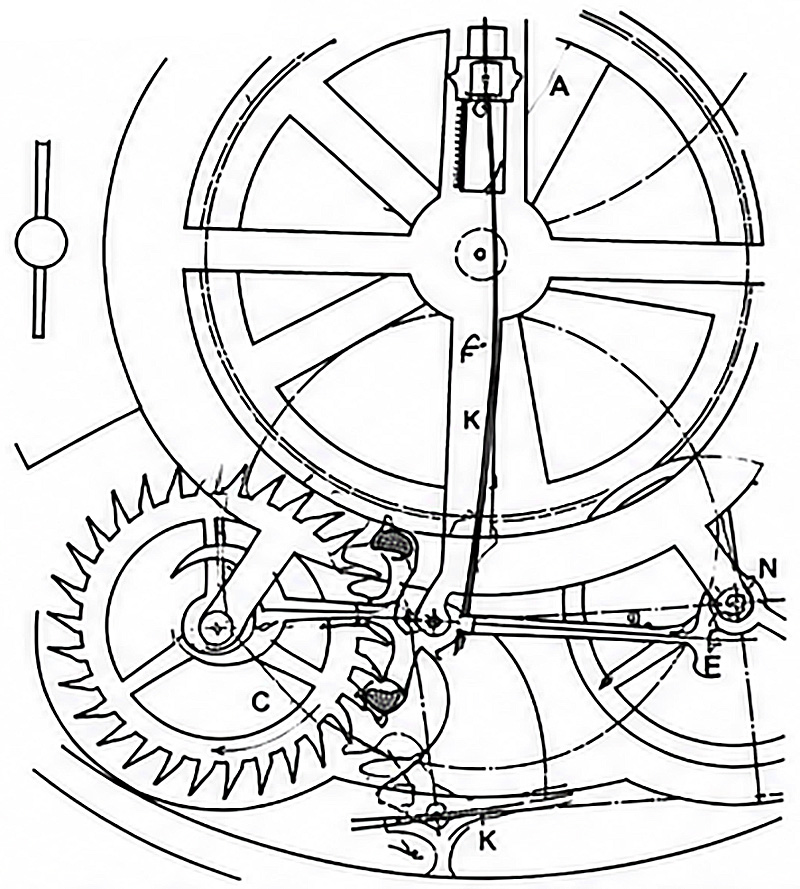
Rack & pinion lever escapement with a STRAIGHT HAIRSPRING K, main-wheel A has 30 teeth, center wheel B has 96 teeth, 3rd wheel C has 96 teeth, 4th wheel M is also the escape wheel. In 1722 Abbé d' Hautefeuille patented this unique rack and pinion lever escapement.
Watch escapement diagram – [Litherland’s Type Raick & Pinion Lever
Escapement]
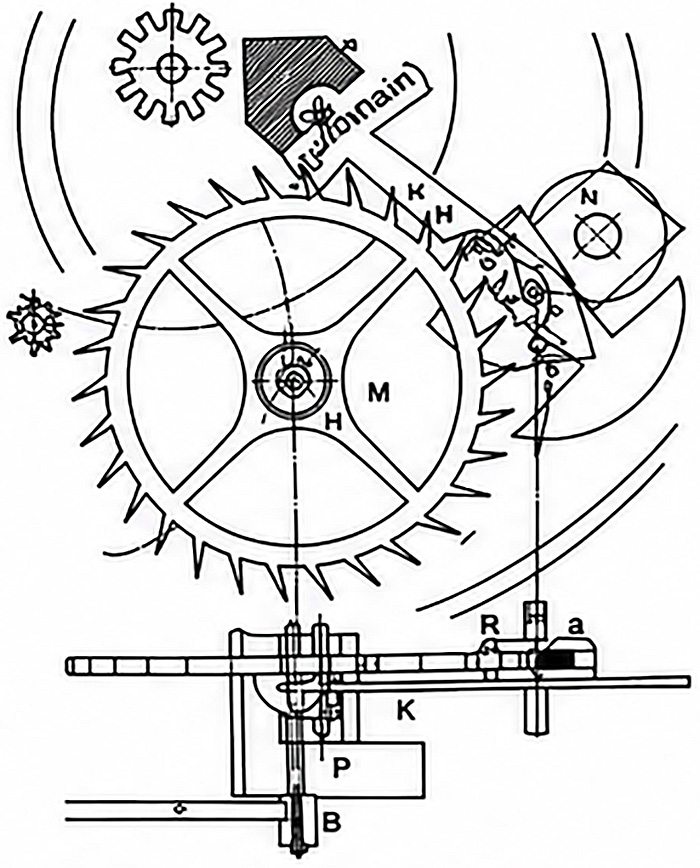
Right A fusee main-wheel drives pinion B of center wheel C, the third wheel F drives pinion G, H is the 4th or escape wheel. The adjustable sliding block N carry the pivot holes for the lever arbor M & depth of lever and escape wheel can be varied.
Watch escapement diagram – [Various Fork Actions]
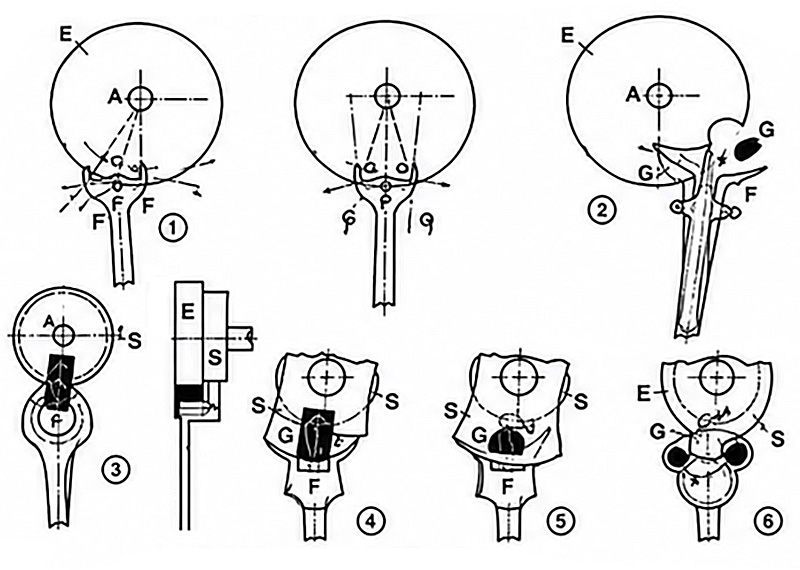
(1.) Savage 2 pin, G is for unlocking, the
pin at F delivers impulse.
(2.) F on the spring fork prevents
breaking of the impulse jewel G when the impulse jewel travels
a full circle.
(3.) The interior of the fork is cylindrical shell of gold.
(4, 5, & 6) Different forms of Louis Huguenin Patents.Watch escapement diagram – [Albert Potter’s One Tooth Escape Wheel Lever (C.1887)]
Watch escapement diagram – [MacDowall with one tooth escape Wheel (C.1851)]
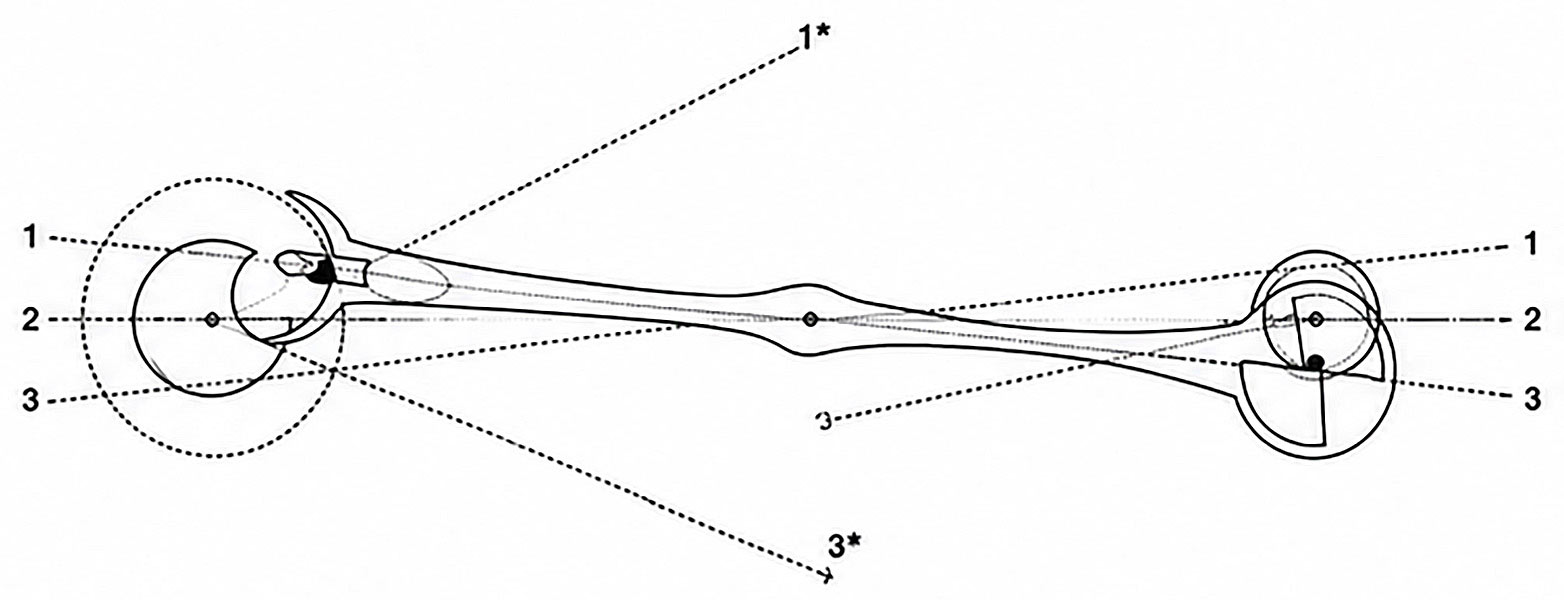
Important Note: Cooksey Shugart acquired the Major Paul M. Chamberlain original hand drawn mechanical drawings of escapements used in his BOOK "Its About Time".
Watch escapement diagram – [One Jewel Pallet Lever By Edouard Bourquin (C. 1875)]
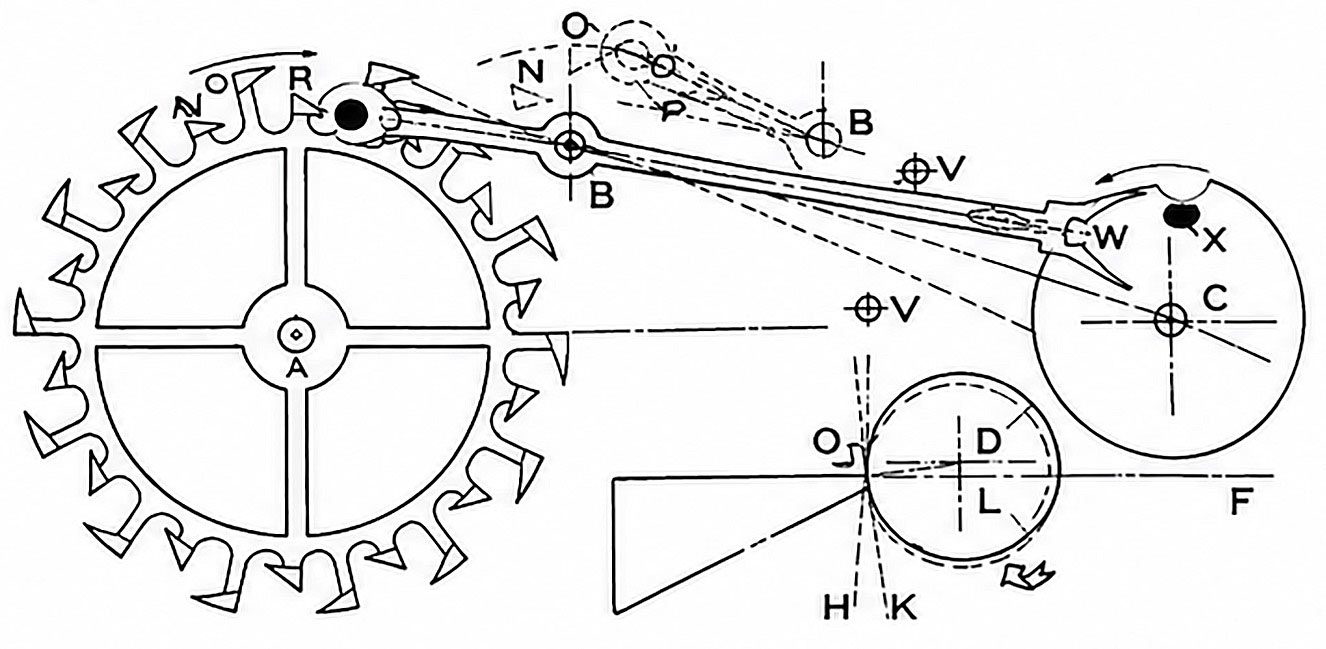
Watch escapement diagram – [Inverted Lever Escapement By Girard - Perregaux (C. 1886)]
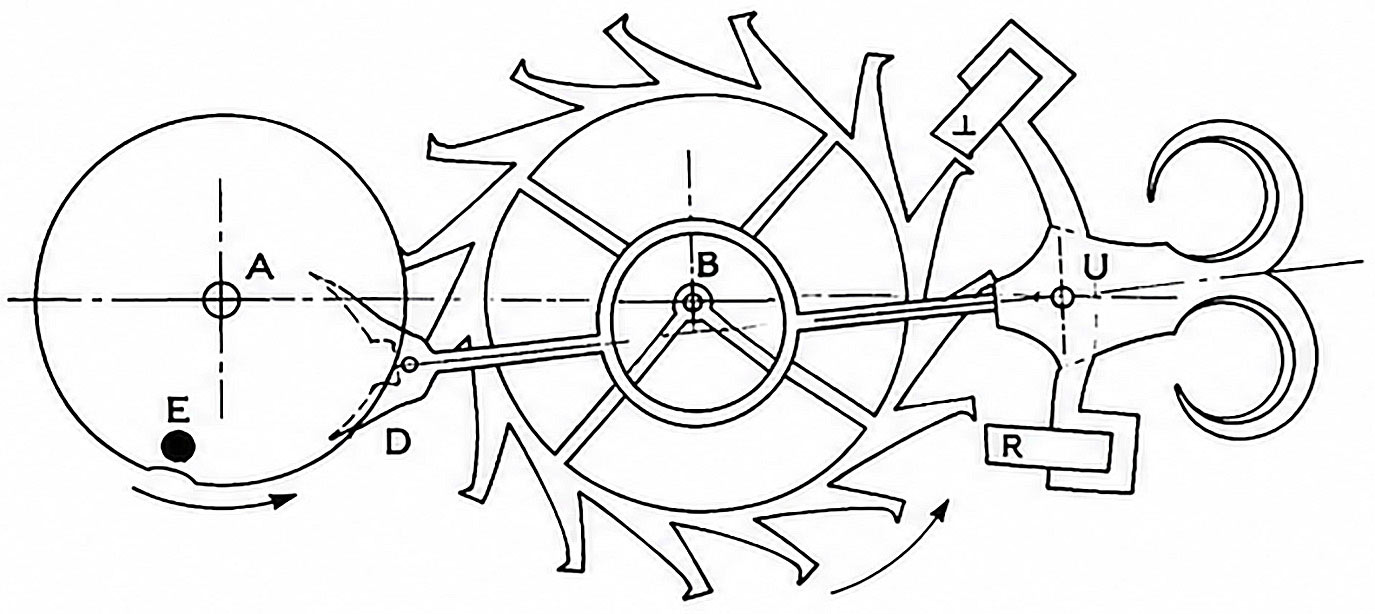
Note: Escapements may be classified into 2 categories Frictional & Detached.
(1.) Frictional Rest Escapements example: Verge, Virgule, Duplex and Cylinder.
(2.) Detached or Free Escapements example: Lever Escapements, Detent Escapements also combination of lever, Detent and Rotating Escapement as Karrusel and Tourbillon.
Frictional Escapements the escape wheel is in contact with the balance staff or a part of it during the complete oscillation of the balance.
Detached or Free Escapements have an arrangement where the escape teeth wheel are arrested for unlocking & impulse & then released. Thus the contact is broken during part of the oscillation.
Watch escapement diagram – [C.V. Woerd patented Escapement]
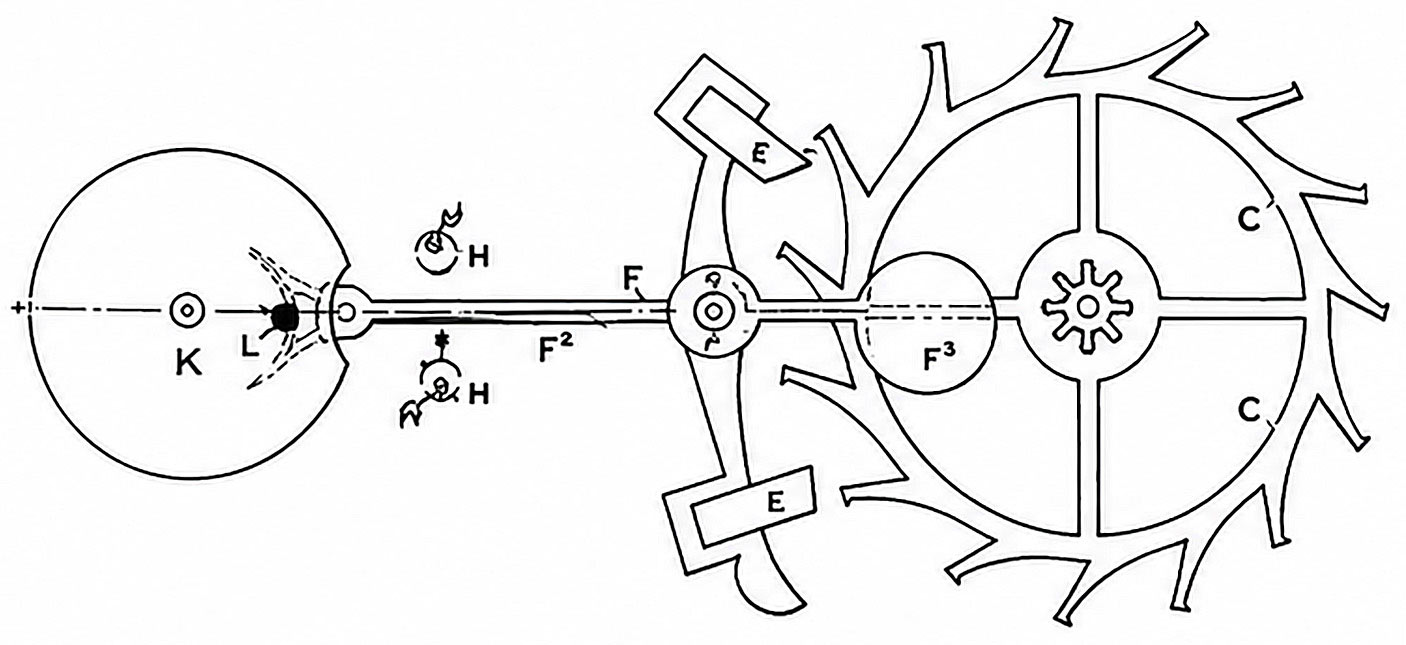
Note: Square Impulse Roller Jewel (L), Pat. in 1887.
Watch escapement diagram – [Seconds Beating Watch Escapement by Joseph Jeunet of Pennsylvania, Pat. in 1858]
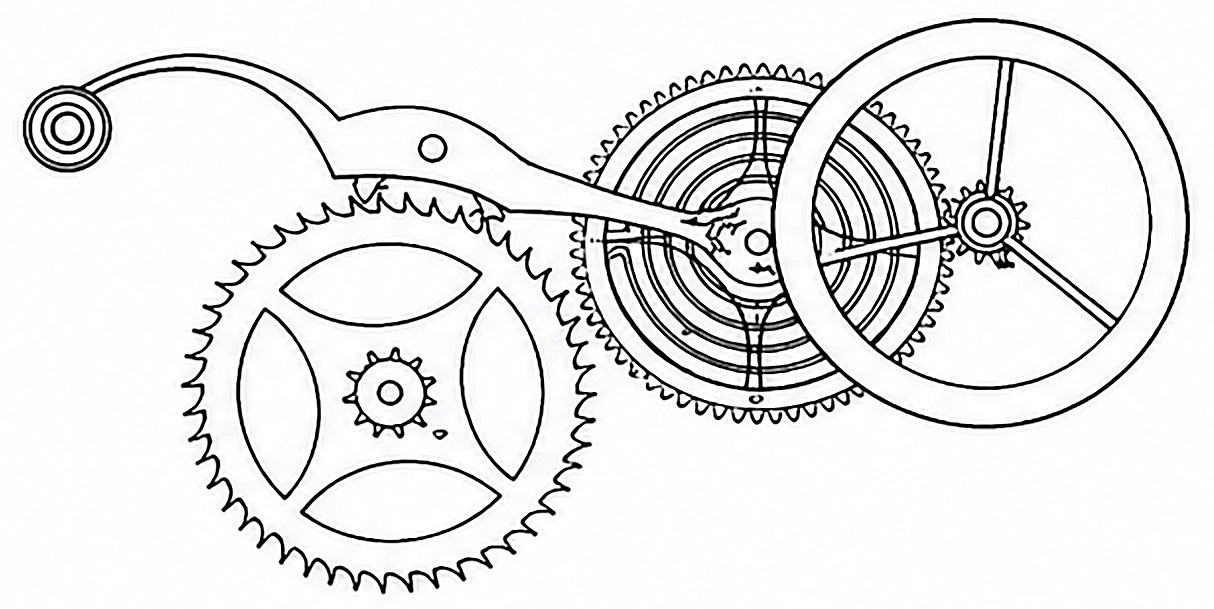
Note: B is the escape wheel with 60 teeth, H is hairspring and D is balance wheel.
Important Note: Cooksey Shugart acquired the Major Paul M. Chamberlain original hand drawn mechanical drawings of escapements used in his BOOK "Its About Time".
Watch escapement diagram – [Detent Escapement By Arnold, Chas. Frodsham]
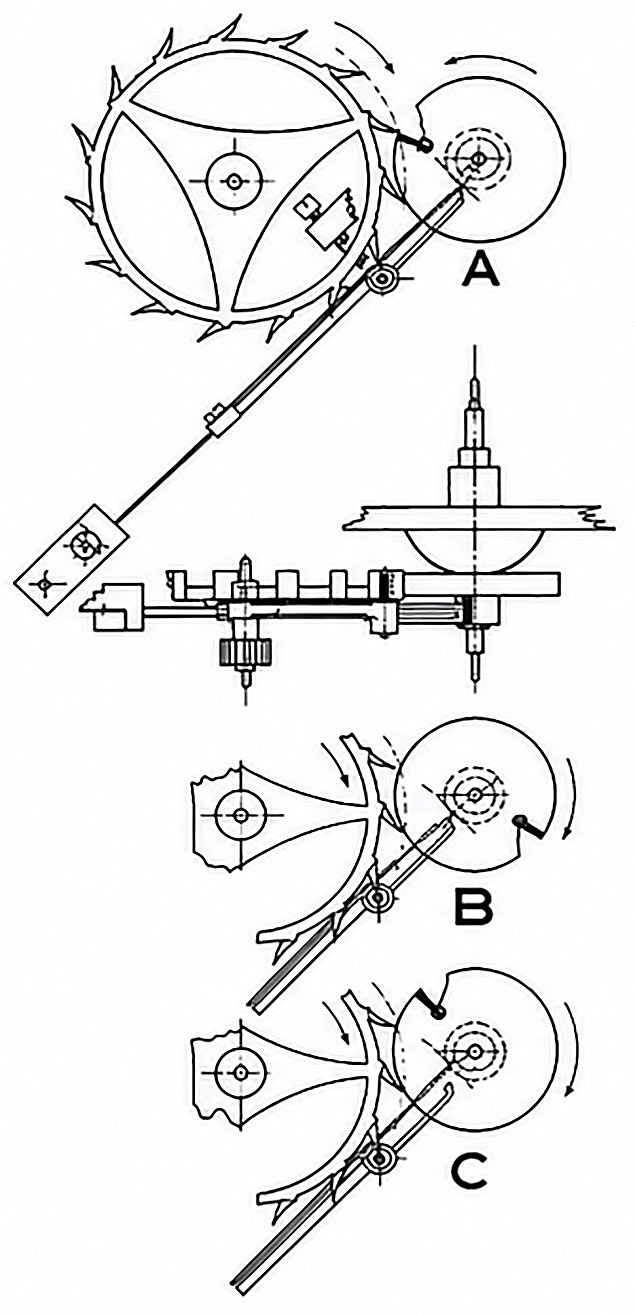
Watch escapement diagram – [Pivoted or Bascule Escapement by James Nardin]
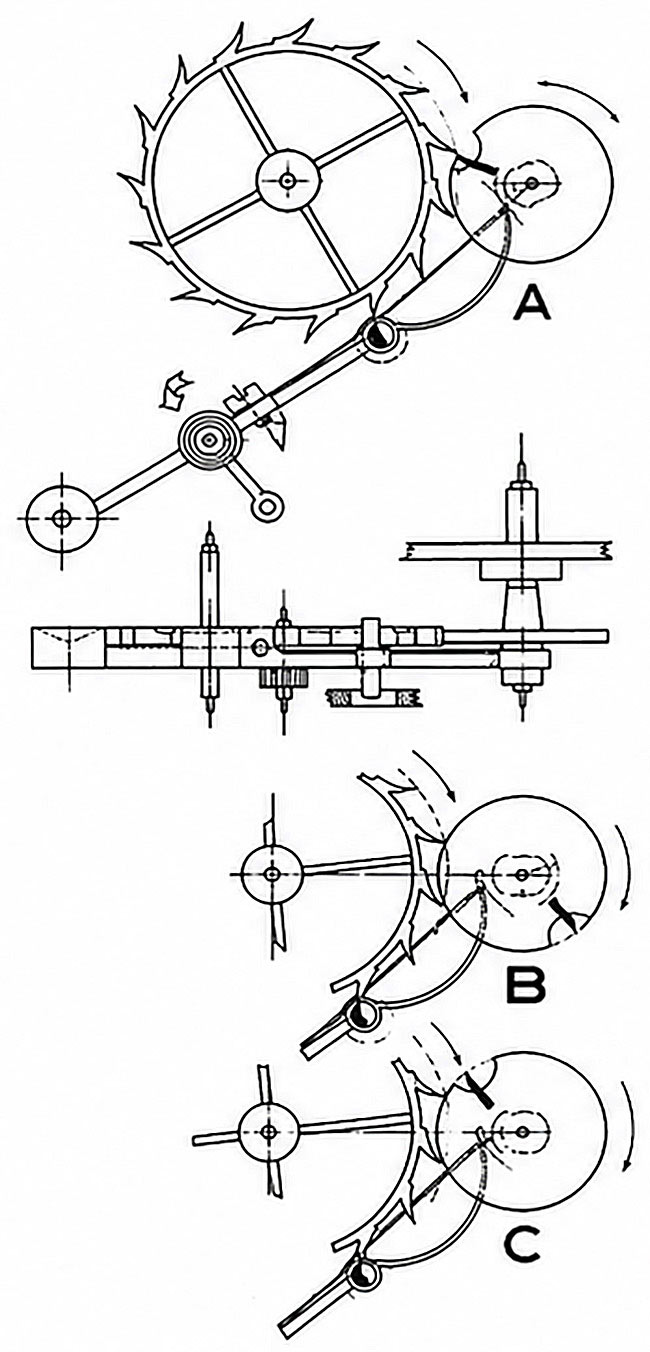
Note: Escapements may be classified into 2 categories Frictional & Detached.
(1.) Frictional Rest Escapements example: Verge, Virgule, Duplex and Cylinder.
(2.) Detached or Free Escapements example: Lever Escapements, Detent Escapements also combination of lever, Detent and Rotating Escapement as Karrusel and Tourbillon.
Frictional Escapements the escape wheel is in contact with the balance staff or a part of it during the complete oscillation of the balance.
Detached or Free Escapements have an arrangement where the escape teeth wheel are arrested for unlocking & impulse & then made free. Thus the Balance can rotate an arc of an oscillation with complete freedom.
Watch escapement diagram – [Detent Escapement by George P. Reed Pat. April 1868]
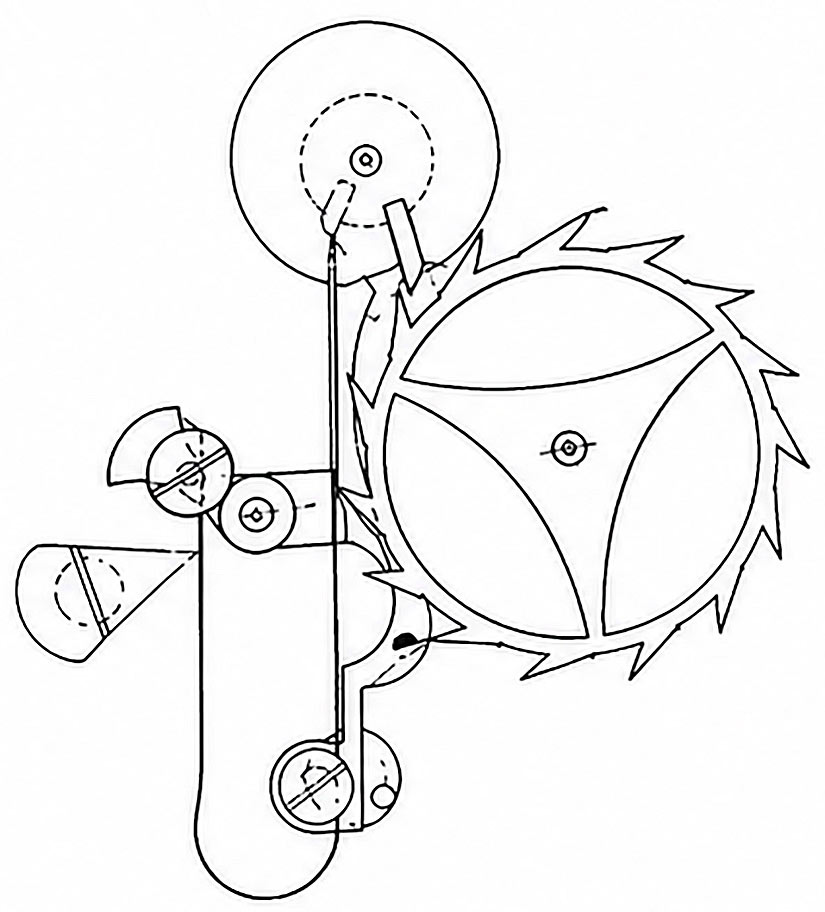
Note: one spring performs the function of hold spring and locking spring.
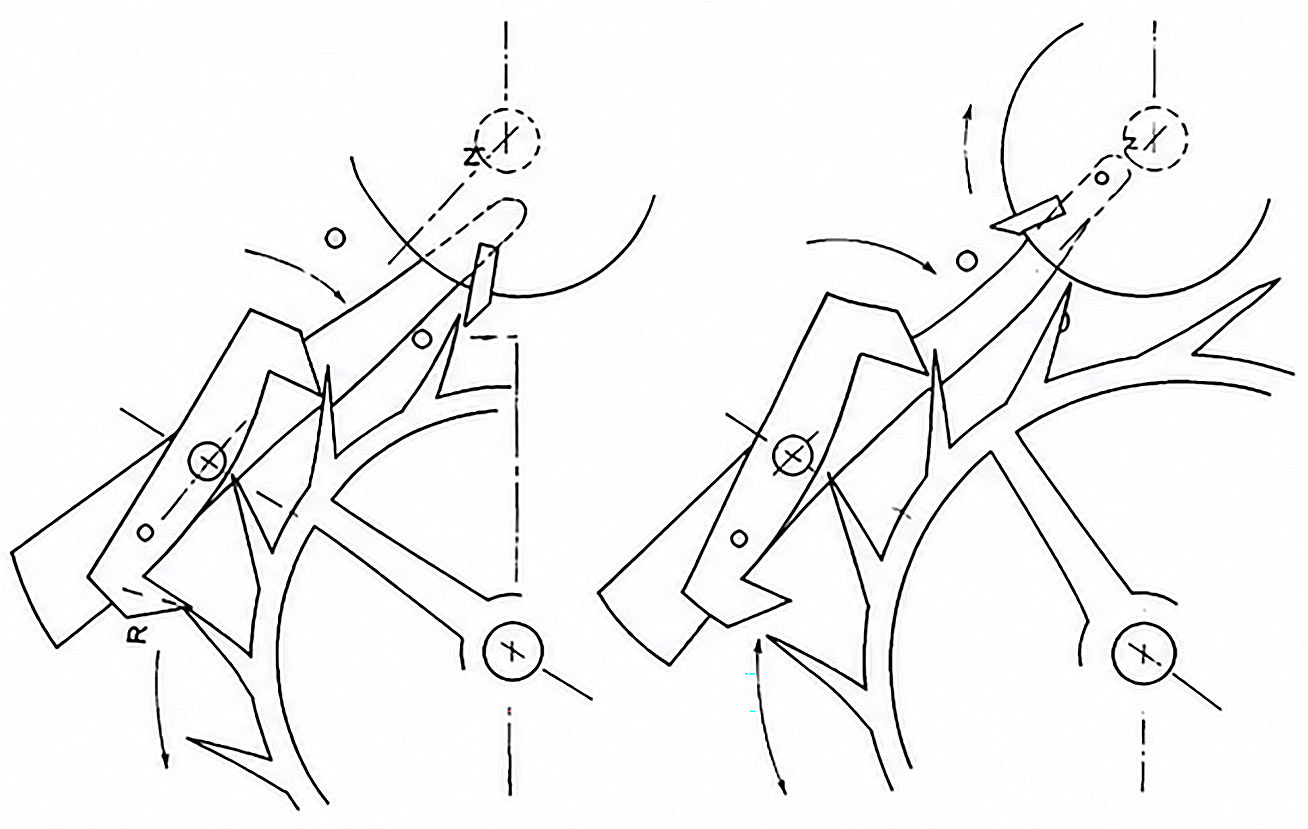
Watch escapement diagram – [English and engraved on movement "Patent Union Chronometer"]
Watch escapement diagram – [Fleurier style Duplex Escapement]
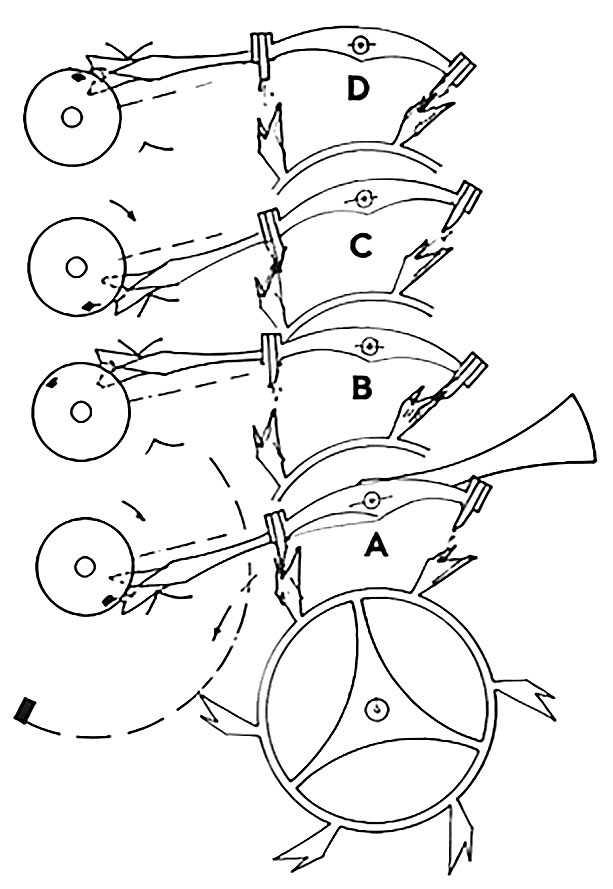
Watch escapement diagram – [English style Duplex Escapement]
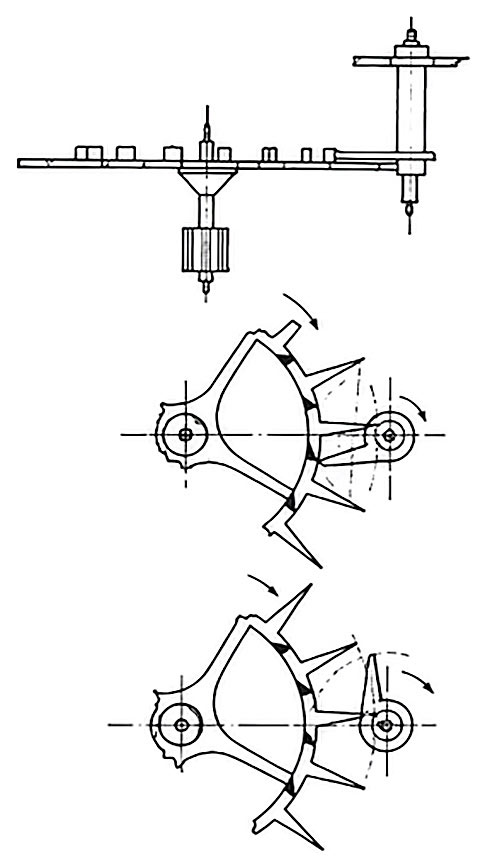
Watch escapement diagram – [Chinese style Duplex Escapement]
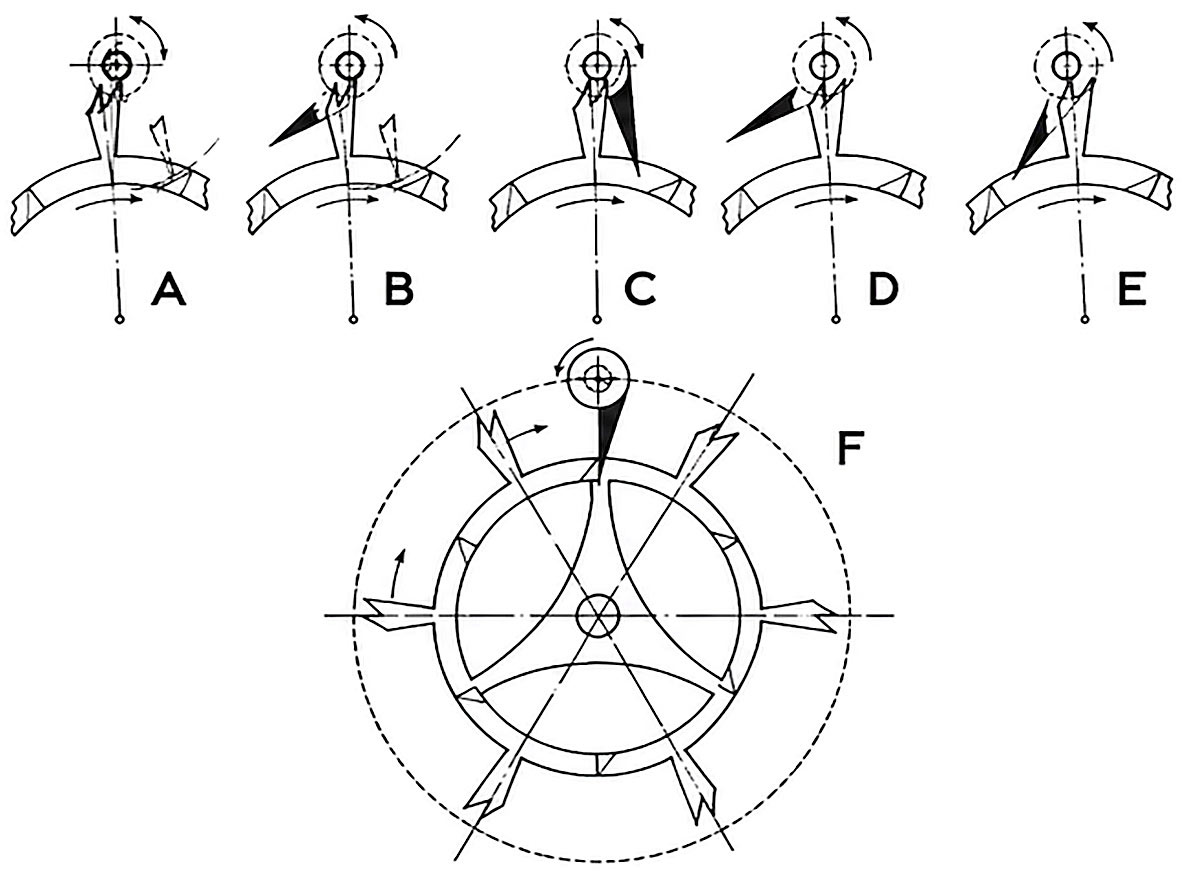
Watch escapement diagram – [Breguets Escapement he called “NATUREL”]
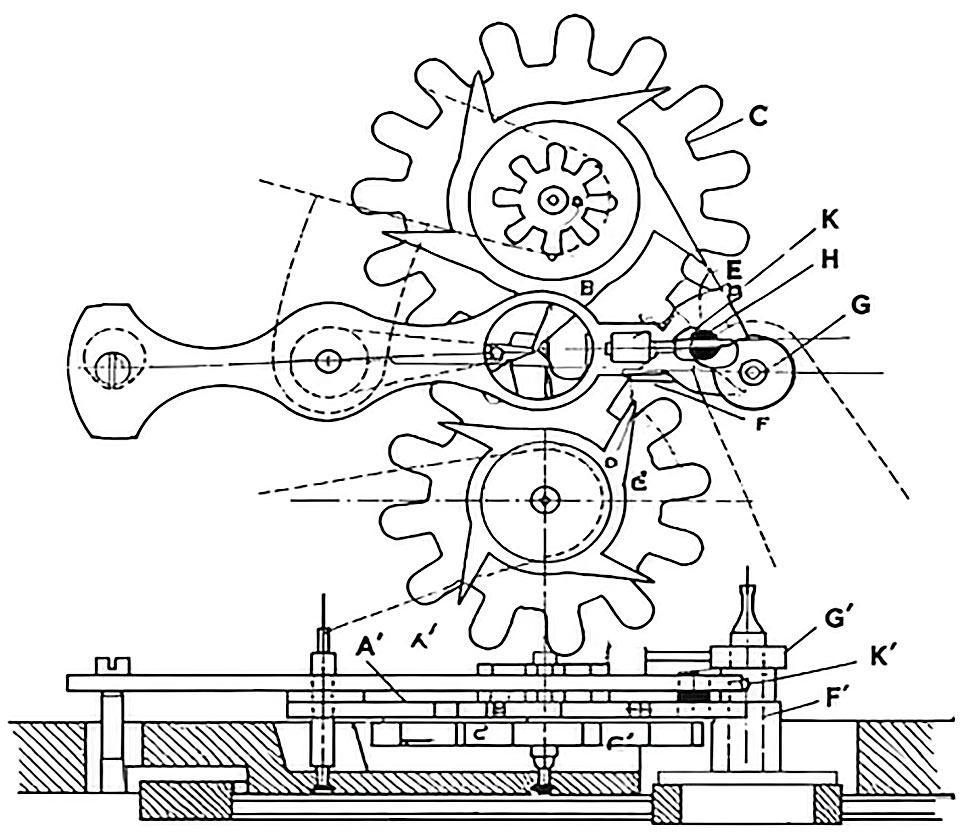
Pinion A drives escape wheels B and B' through gears C and C'. The escape wheel B is locked on D. The locking point D is about to be unlocked by the balance through the ruby pin H and fork K. The tooth following B will deliver impulse to the balance through E, and the tooth B' will lock on D. In the return of the balance, impulse will be delivered in opposite direction through F, acted on by tooth following B'.
Watch escapement diagram – [Breguet Hanging Ruby Cylinder (C), Parachute shock absorber (E) and Temperature device (F)]
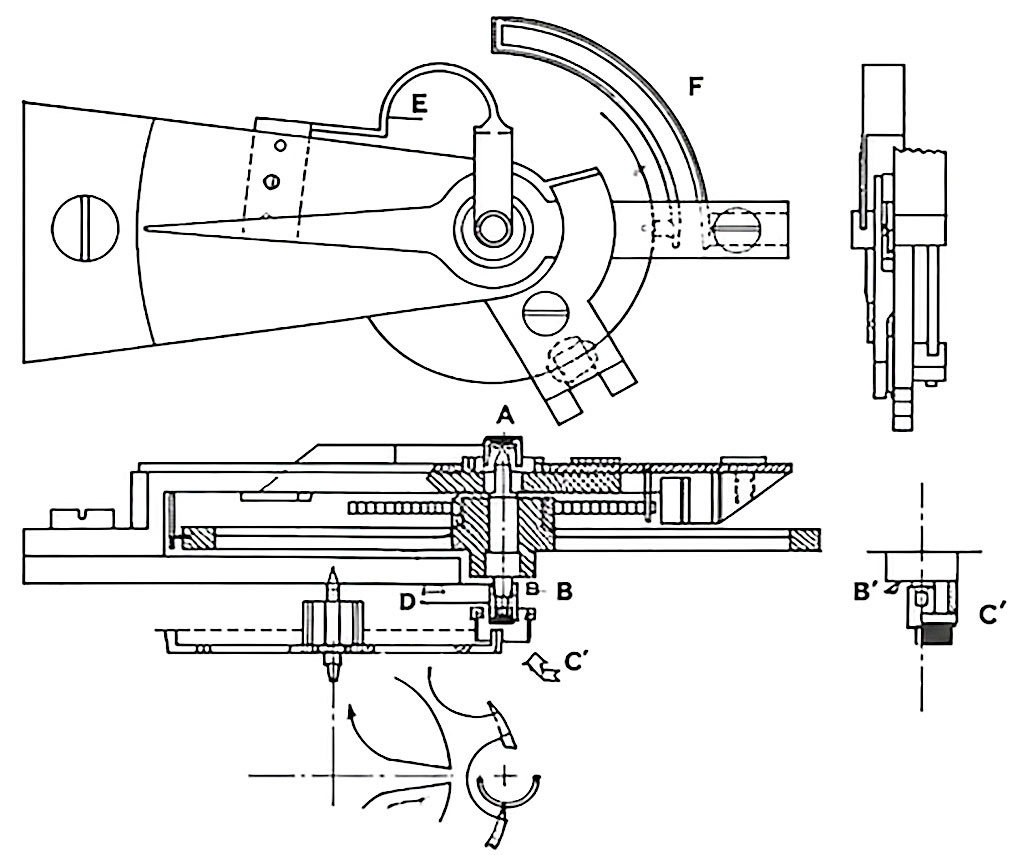
Watch escapement diagram – [Breguet Lateral Lever Escapement]
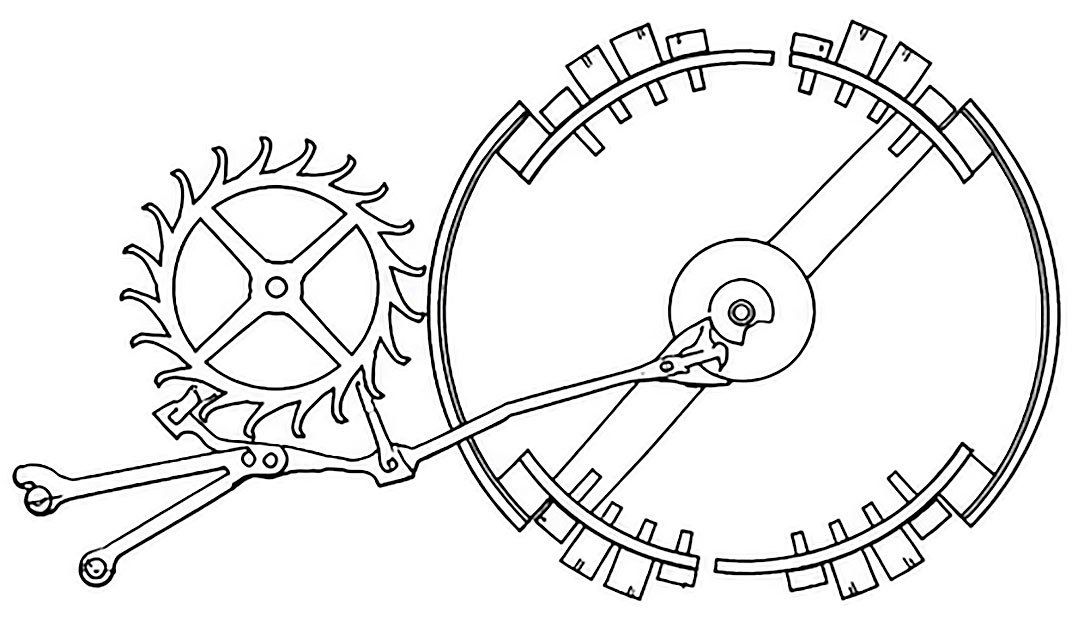
Watch escapement diagram – [Arnold Chronometer Detent Escapement, Pat. in 1782 and Helical balance spring (L), Pat. in 1776]
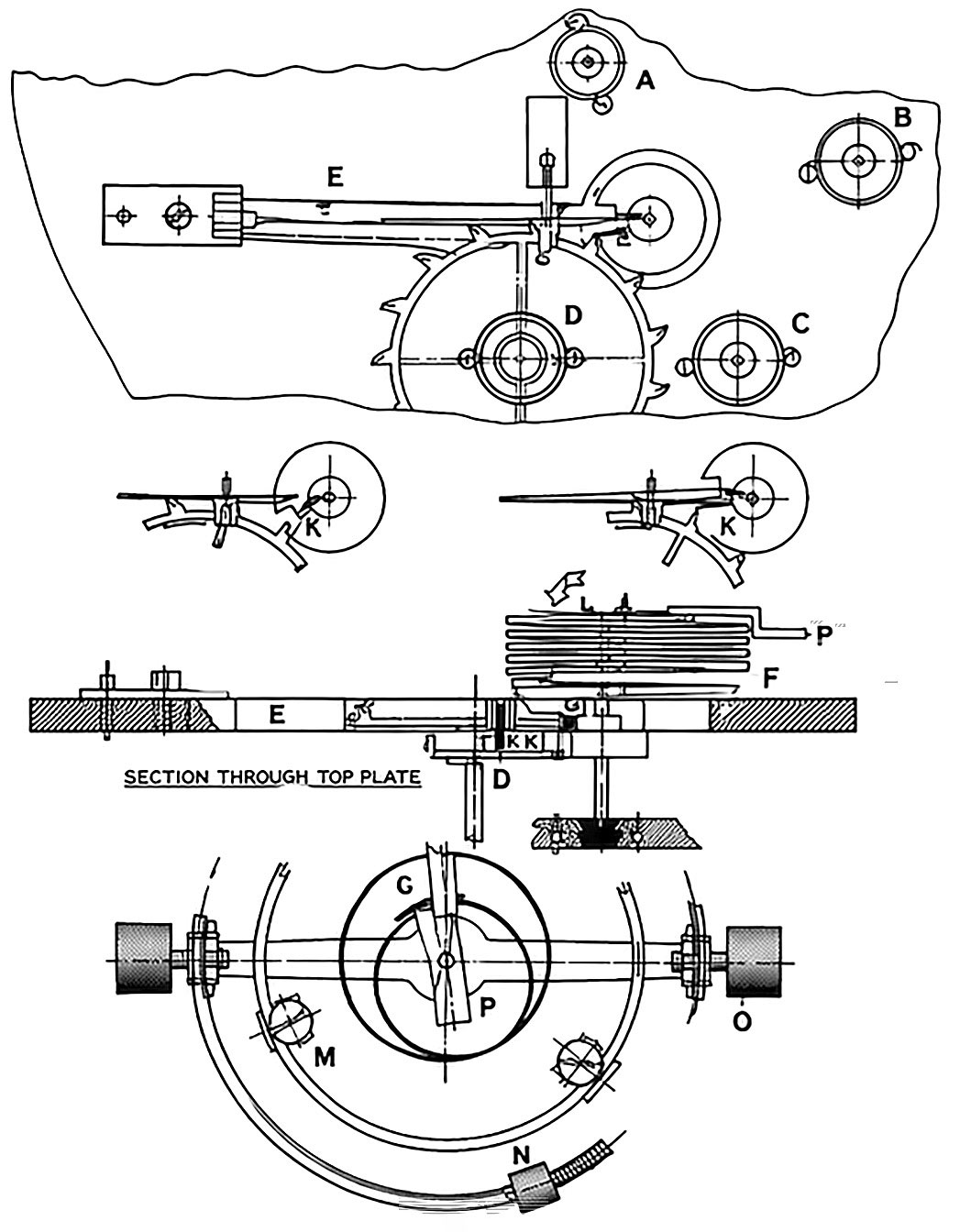
Watch escapement diagram – [Robin Escapement with Anti-overbanking]
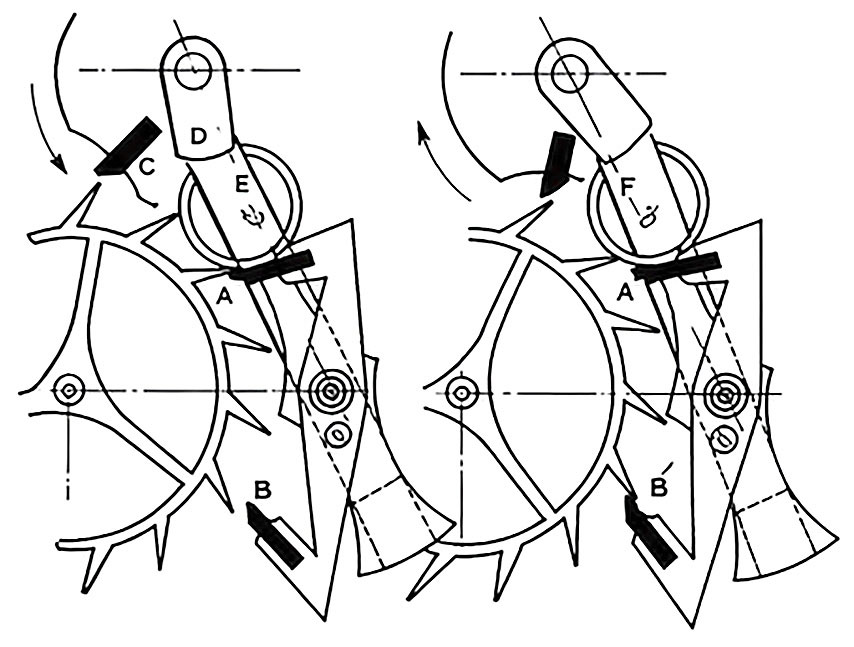
Note unusual form of fork with two springs E & F.
Watch escapement diagram – [Robin escapement with Duplex escape wheel]
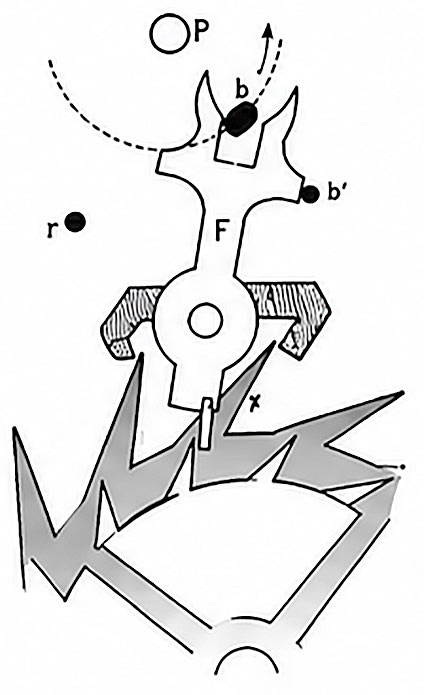
Watch escapement diagram – [Typical Robin escapement]
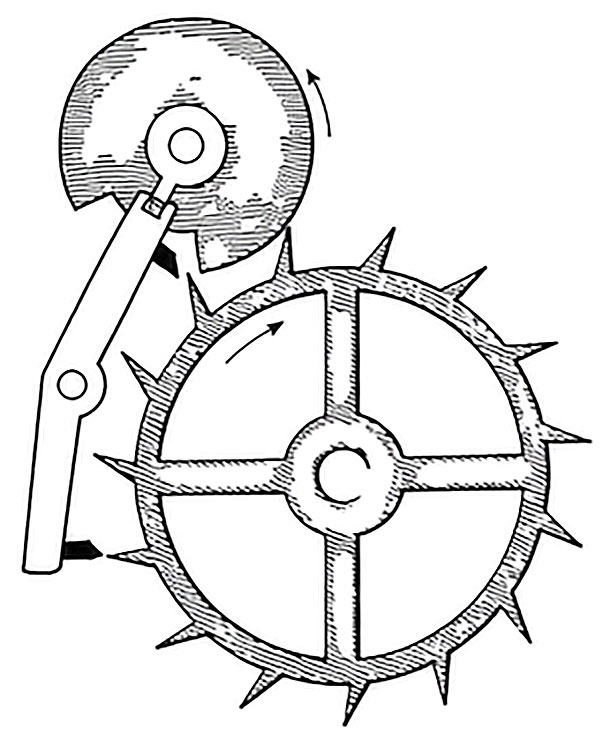
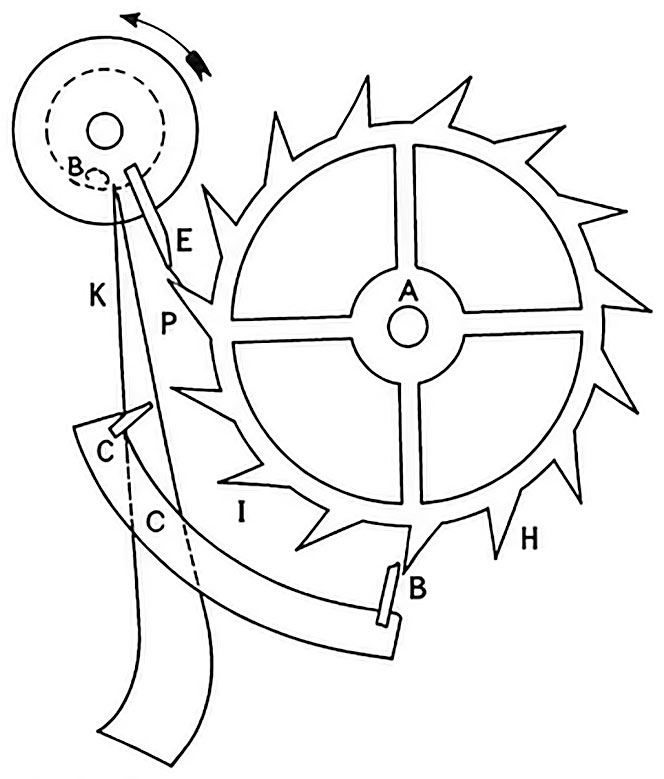
Watch escapement diagram – [Robin escapement, requires over a full turn for locking & unlocking]
Watch escapement diagram – [Glashütter Anker-Hemmung]
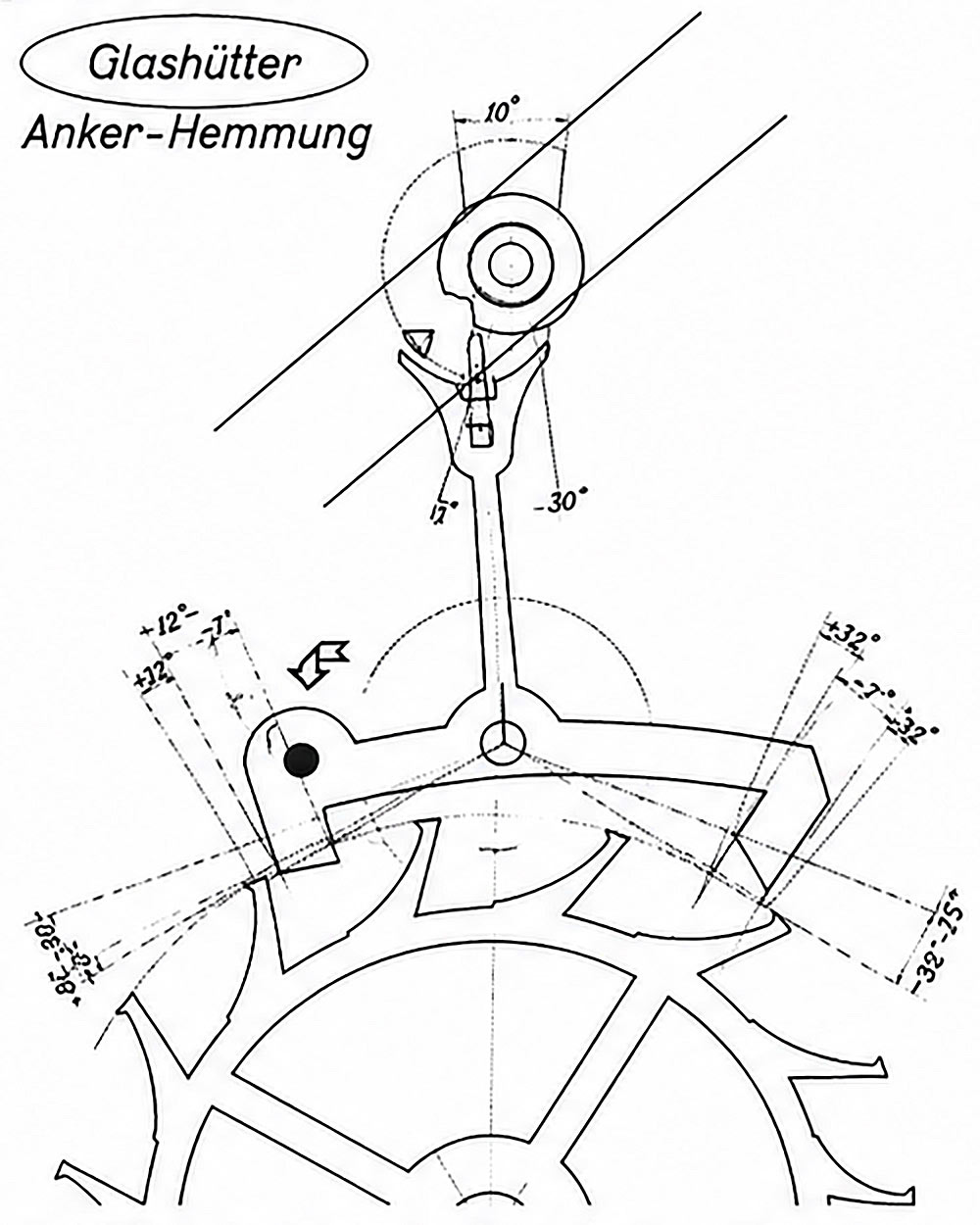
Note: Glashutter = Glashutte, Anker = Pallets and Lever, Hemmung = Escapement.
Note: The One Banking Pin in lever.
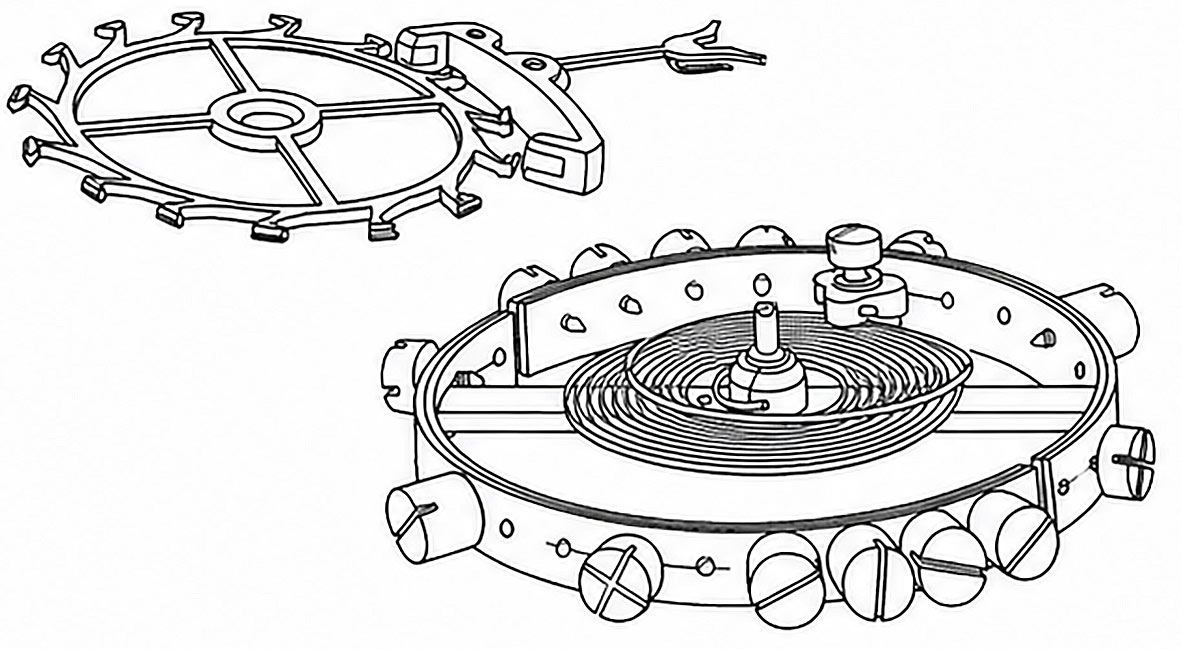
Watch escapement diagram – [Constant Force Escapement]
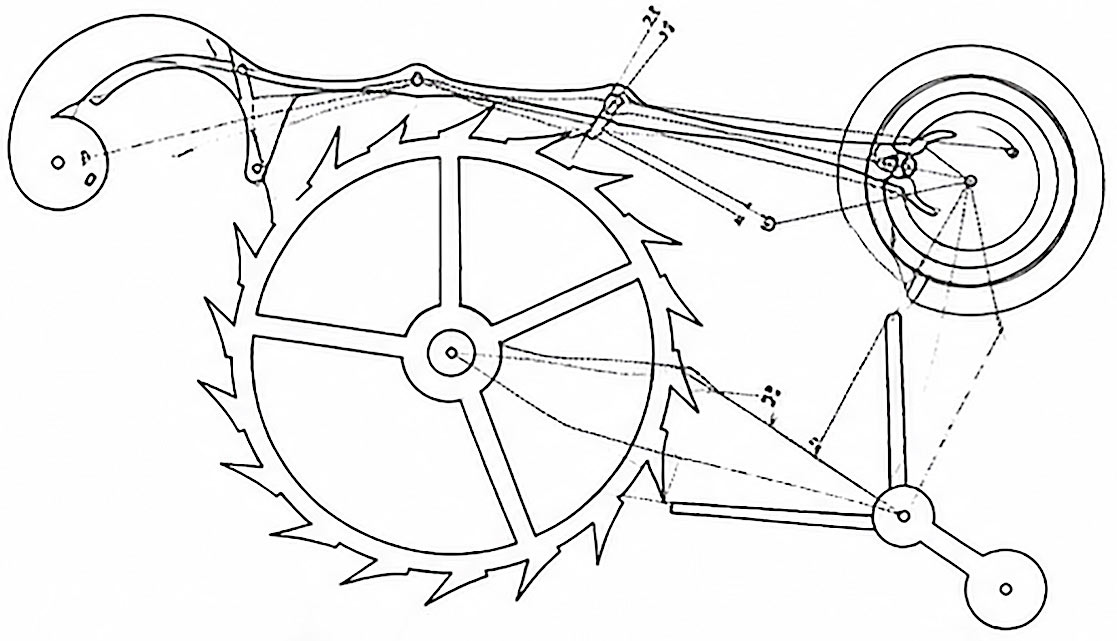
Watch escapement diagram – [M. B. Pray cylinder escapement, the escape wheel is all in one plane]
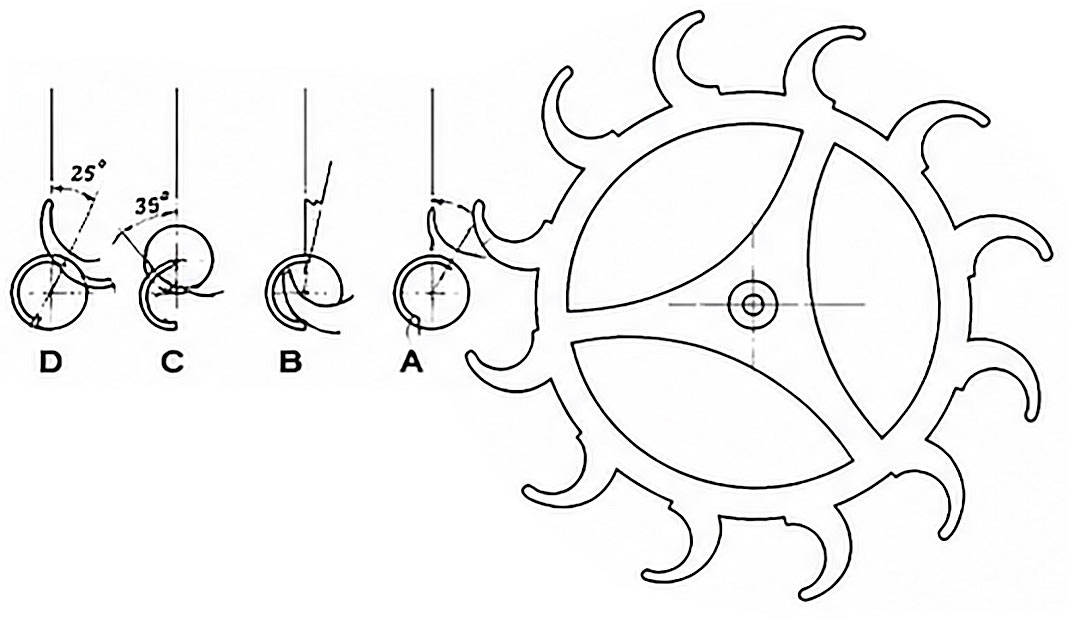
Watch escapement diagram – [Two pin style Savage escapement]
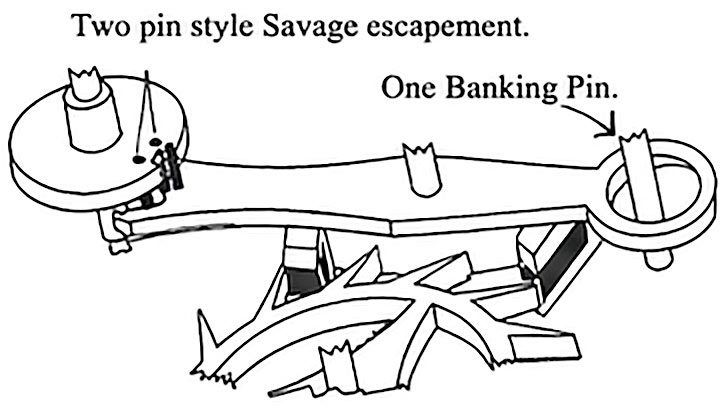
Note: It has one banking pin.
Watch escapement diagram – [Peto's Chronometer Escapement]
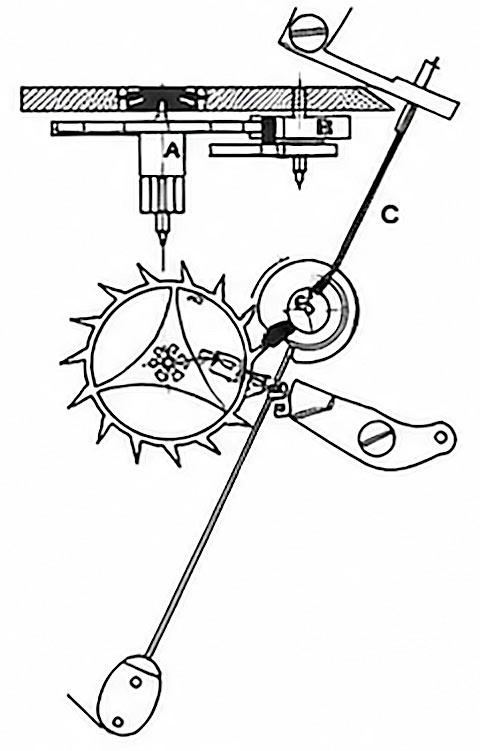
Note: C is similar to a Hold spring and E is similar to passing spring.
Continue Exploring