
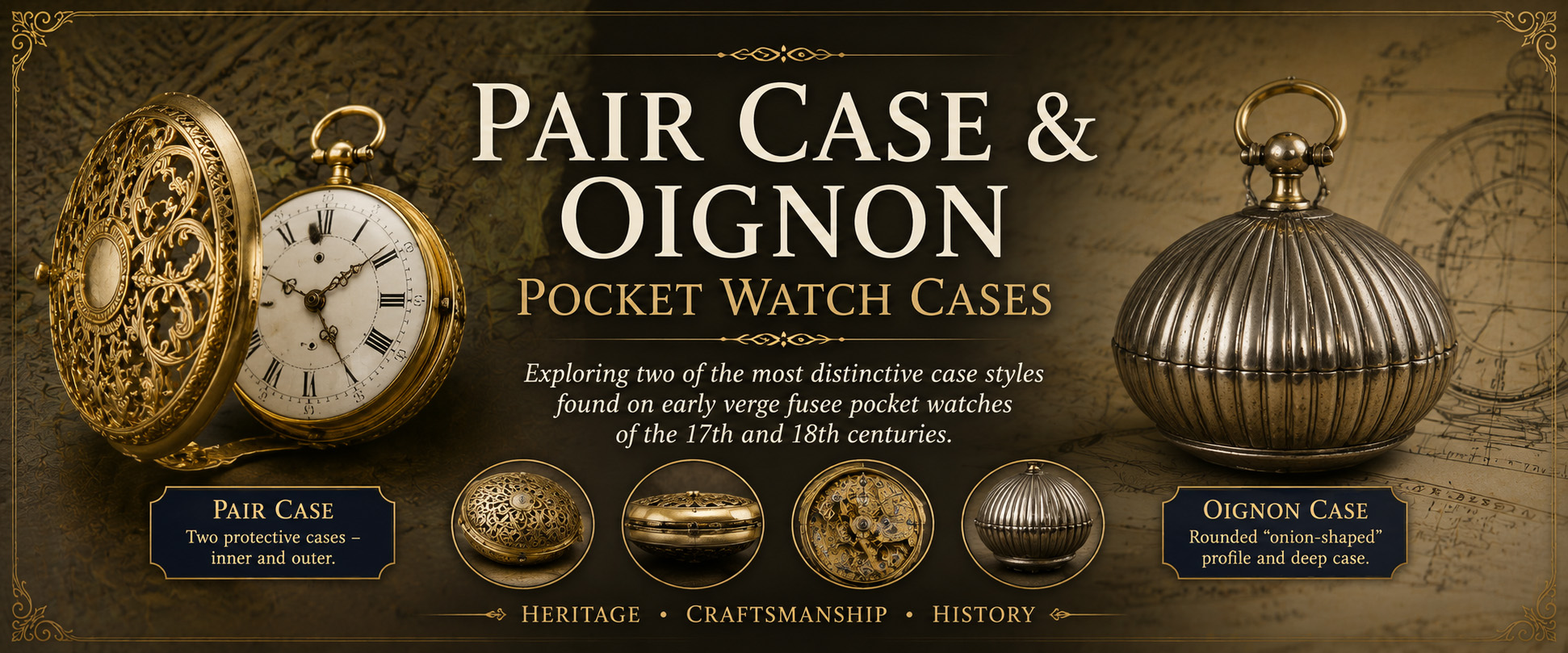
 Pair Case & Oignon Pocket Watch Cases
Among the earliest and most distinctive pocket watch case styles are the Pair Case and Oignon designs. Both are commonly associated with 17th and 18th century verge fusee watches and represent important stages in the evolution of portable timekeeping. Understanding these case styles helps collectors identify and appreciate some of the oldest surviving pocket watches.
What Is a Pair Case?
A Pair Case watch consists of two separate cases:
- An inner case that houses and protects the movement.
- An outer protective case that surrounds the inner case.
The outer case was designed to shield the watch from dirt, moisture, and damage during everyday use. When checking the time, the owner would open the outer case to reveal the inner watch.
Pair cases were especially popular during the late 1600s and throughout much of the 1700s. Many English verge fusee pocket watches were originally sold in pair cases.
Characteristics of Pair Cases
- Two-piece protective design
- Common on English verge fusee watches
- Often crafted in silver, gold, tortoiseshell, shagreen, or leather-covered materials
- Frequently feature pierced or decorative outer cases
- Typically associated with 17th and 18th century watches
Example: Many English pocket watches by makers such as Thomas Tompion, George Graham, and other prominent London watchmakers were originally housed in pair cases.
What Is an Oignon Case?
The term Oignon is derived from the French word for "onion." These watches are easily recognized by their large, rounded, bulbous cases that resemble the shape of an onion.
Oignon watches were produced primarily during the late 17th century and early 18th century. Their oversized dimensions allowed room for the relatively large verge fusee movements used during this period.
Characteristics of Oignon Cases
- Rounded "onion-shaped" profile
- Thick, deep case construction
- Usually larger than later pocket watches
- Commonly found on French and Continental European watches
- Often contain verge fusee movements
- Produced primarily during the late 1600s and early 1700s
Oignon watches are among the most recognizable forms of early portable timepieces and remain highly sought after by collectors of early horology.
Pair Case vs. Oignon
| Pair Case | Oignon Case |
|---|---|
| Describes a double-case construction | Describes the shape of the case |
| Common on English watches | Common on French and Continental watches |
| Consists of inner and outer protective cases | Characterized by a rounded bulbous form |
| Used primarily for protection | Designed around early movement architecture |
A watch can theoretically possess both characteristics. The terms describe different aspects of the watch: one refers to construction, while the other refers to shape.
Why Collectors Value These Early Case Styles
Pair case and oignon watches represent some of the earliest surviving forms of portable timekeeping. Because many examples date back more than 250 to 350 years, original cases are highly desirable to collectors.
Watches retaining their original cases often command significantly greater interest than examples that have been recased or altered. These historic case designs also provide insight into the craftsmanship, fashion, and technological limitations of watchmaking during the formative years of horology.
Learn More About Early Pocket Watches
Explore Verge Fusee Pocket Watches →
Learn About Watch Escapements →
Return to Watch Terminology Glossary →
Browse Pair Case & Oignon Pocket Watches Available for Sale →